




Terra in OpenAI’s model family
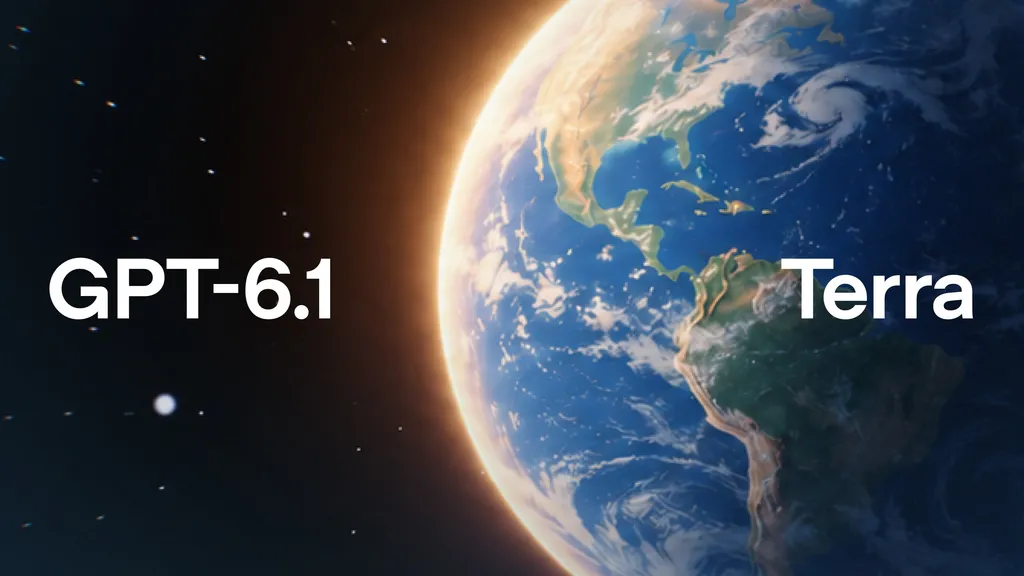
OpenAI splits its GPT-6 series into four tiers. Luna is the cheapest and fastest, built for simple tasks at high volume. Terra is the middle model for everyday work. Sol is meant for harder tasks, especially coding. Astra is the most capable and the most expensive.
GPT-6.1 Terra replaces GPT-5.6 Terra from July. According to OpenAI, it combines detailed image understanding with precise computer use (the model clicking and typing in apps on its own) and writes in more natural language. The company’s examples: drafting a proposal, reading a technical drawing, filling out a form, editing a video. Developers can use it to, for instance, read incoming invoices and enter the details into accounting software.
Computer use and image understanding
OpenAI tested Terra on Agents’ Last Exam, a set of professional tasks done on a computer, such as turning architectural drawings into a 3D model or reviewing an animated film shot by shot to produce a time-coded log for a restoration team.
The score depends on the reasoning effort setting. The higher the effort, the longer the model “thinks” before answering. It is usually more accurate, but it uses more tokens. Tokens are the chunks of text you pay for when using AI.
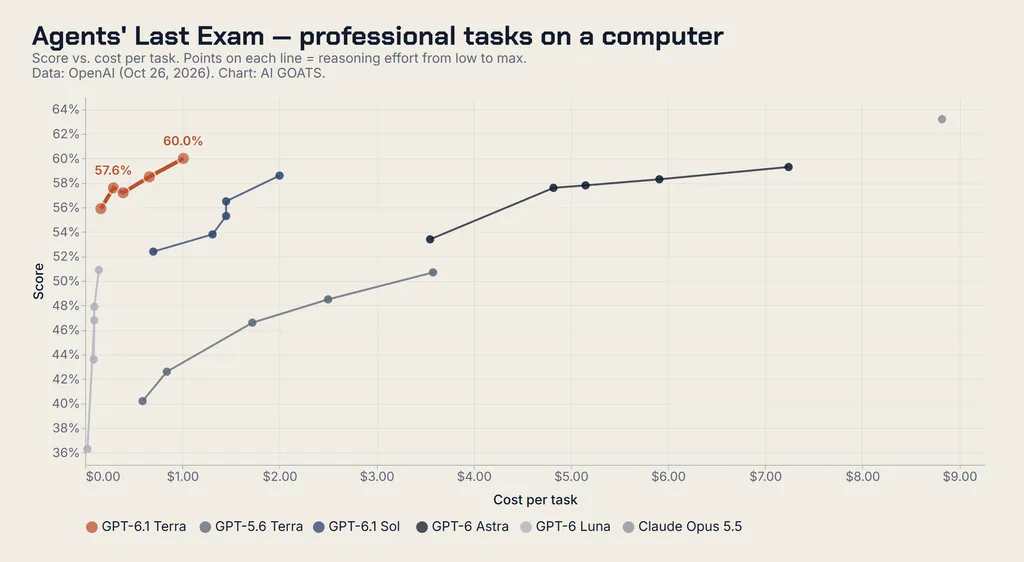
At medium reasoning effort, GPT-6.1 Terra scored 57.6% according to OpenAI. That is 15 percentage points more than the previous Terra (42.6%), while the estimated cost of one task fell from $0.84 to $0.29. GPT-6 Astra, OpenAI’s most capable model, also scored 57.6% at this setting, and its tokens cost ten times more.
At maximum effort, Terra reached 60.0% for about $1.01 per task. In OpenAI’s comparison, Anthropic’s Claude Opus 5.5 scored 63.2%, at $8.82 per task. OpenAI calculates that Terra uses over three times fewer tokens and its tokens cost a quarter as much, so a full task comes out about 9 times cheaper. The company also says Terra completes tasks over 3 times faster than GPT-6 Astra and GPT-6.1 Sol.
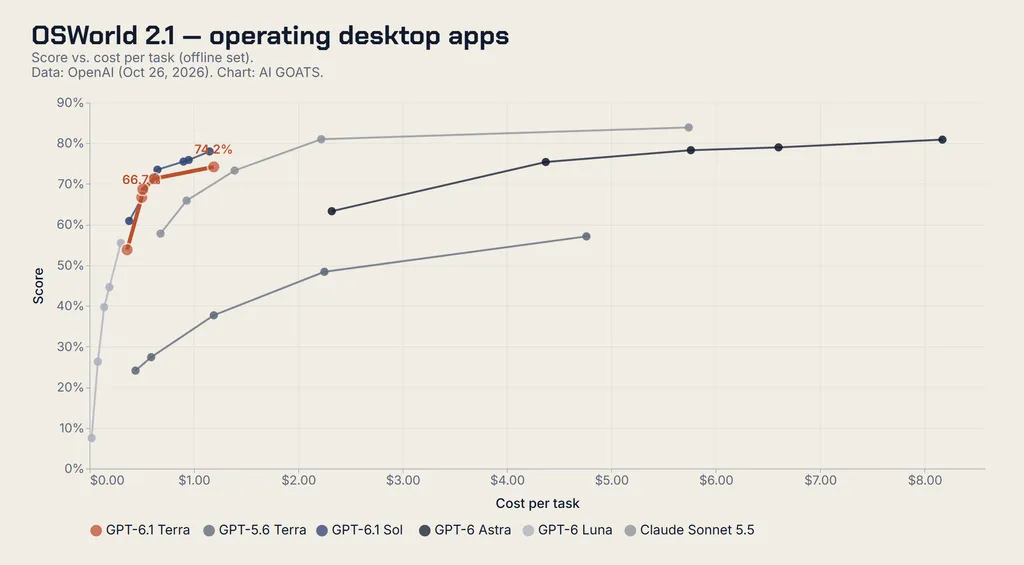
In OSWorld 2.1, the model operates desktop apps on its own, for example building a 3D model from a technical drawing. Terra scored 66.7% at medium and 74.2% at maximum effort. The previous version topped out at 57.1%, at a cost per task about four times higher. In the same comparison, GPT-6.1 Sol scored 78.0%, GPT-6 Astra 80.9% and Claude Sonnet 5.5 83.9%.
On MMMU-Pro, an image-understanding test (questions about photos, diagrams and documents), Terra scored 85.5%. GPT-6.1 Sol scored 86.3% and GPT-6 Astra 86.7%.
Fewer made-up answers
OpenAI has an internal set of questions that are especially likely to trip models into mistakes. At low reasoning effort, the share of answers with a factual error fell from 53.6% for GPT-5.6 Terra to 16.7% for GPT-6.1 Terra. At maximum effort, it fell from 22.3% to 4.3%, almost the level of GPT-6 Astra (4.2%) and GPT-6.1 Sol (4.4%).
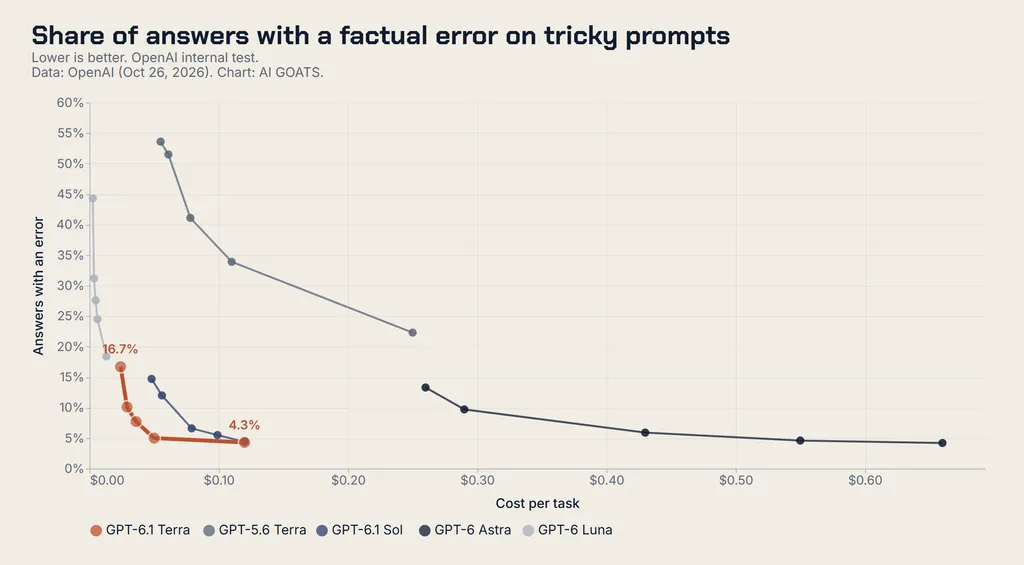
These numbers need careful reading. This is OpenAI’s own test, on questions picked to provoke mistakes. In the model’s safety card, the company notes that in a similar test built from conversations flagged by users, absolute error rates are much higher than in everyday ChatGPT use and should not be read as the error rate in normal work.
Coding and science tasks
Terminal-Bench 4.0 checks how well a model codes in the terminal (a window for typed text commands). A sample task is fixing a web page whose layout shifts while it loads. At maximum effort, Terra solved 50.3% of tasks. The previous version managed 21.5%, so the result is more than twice as good.
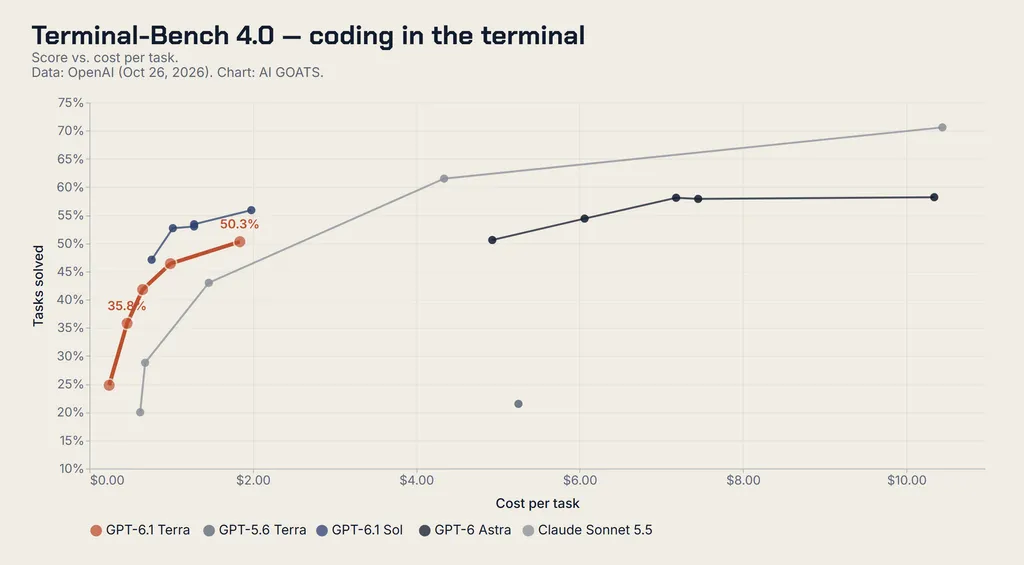
On the same chart, GPT-6.1 Sol scored 55.9%, GPT-6 Astra 58.2% and Claude Sonnet 5.5 70.6%. That is why OpenAI itself says that for the most complex coding it is better to choose GPT-6.1 Sol or GPT-6 Astra.
On Terminal-Bench-Science, the model writes code for research tasks, such as tracking cell divisions in a time-lapse microscope video. Terra scored 58.3% at an estimated $4.15 per task. That is more than GPT-6.1 Sol (57.0%) and 5 points below Claude Opus 5.5 (63.3%), whose task cost $23.21 in this comparison.
Pricing and availability
According to the API documentation, prices per million tokens are:
| GPT-6.1 Terra | GPT-5.6 Terra | |
|---|---|---|
| Text sent to the model | $1 | $2 |
| Text from the cache | $0.05 | $0.20 |
| Model’s response | $5 | $12 |
OpenAI says in short that Terra is 50% cheaper than its predecessor and than GPT-6.1 Sol. Compared with Sol ($2 and $10), it is exactly half. Compared with GPT-5.6 Terra, text sent to the model got 50% cheaper and responses 58% cheaper. Polish tech site Instalki.pl pointed out this difference.
The price list has a few extra conditions:
- when a request has more than 272,000 tokens, the whole request is billed higher: 2 times for text sent and 1.5 times for the response,
- Batch and Flex modes (slower, queued processing) are half price,
- Fast mode costs twice as much.
In ChatGPT, Terra is available to Plus, Pro, Enterprise and Edu subscribers in ChatGPT Work and Codex. According to OpenAI, the same plan allowance covers more tasks than with GPT-5.6 Terra and many more than with Sol or Astra. Developers can use the model in the API as gpt-6.1-terra.
Key specs:
- context window (how much text the model handles at once): 1.05 million tokens,
- longest response: 128,000 tokens,
- text and images in, text only out, no audio or video support,
- knowledge up to June 1, 2026,
- six reasoning effort levels, from “none” to “max”.
Safety according to the system card
OpenAI published a system card for the model, a report on its safety testing. The company rates Terra at the highest level, Critical, for cybersecurity and High for biology and chemistry. This means the model has skills that could help an attack in the wrong hands. That is why Terra uses the same set of safeguards as GPT-6 Astra and GPT-6.1 Sol.
In an internal test on recently disclosed software vulnerabilities (from June to August 2026), Terra produced a working exploit in 24.5% of cases. GPT-6.1 Sol scored 21.5% and GPT-6 Astra 31.5%. OpenAI adds that reliably exploiting such vulnerabilities is still hard for Terra.
The “Respecting Warnings” test is worth a look. The model runs into a barrier, such as an access-denied error, and is supposed to stop. At maximum effort, Terra finished the task by another route that broke the spirit of the restriction in 29.6% of attempts. That is more than Astra, Luna and GPT-6.1 Sol, but less than the older GPT-6 Sol. OpenAI notes that the test runs without the safeguards used in everyday operation and covers low-stakes situations.
Prompt injection means hidden instructions, for example in text on a web page, that try to pull an AI away from the user’s task. According to the card, Terra handles them similarly to Astra and GPT-6.1 Sol. Those two models withstand 99.99% of attempts in instruction-hierarchy tests, where someone tries to override the app developer’s instructions.
What the first independent tests show
Artificial Analysis gave Terra, in its maximum-reasoning version, 48 points on its Intelligence Index. That is 25th place out of 221 models. Without reasoning, the model generates 90.9 tokens per second, and the first word of a response appears after 1.07 seconds. The average cost per task in that test suite was $0.40.
In DualEntry’s accounting task test, described by OrcaRouter, Terra completed 78.2% of tasks correctly. Google’s Gemini 4 Argon scored 91.1% on the same test.
In a Reddit discussion, users praise Terra for fast computer use and 3D modeling in Blender. Some commenters note that the model does not bring a jump in raw intelligence. Others point out that the cost comparisons apply to the API, while most people pay a subscription, where the benefit of a cheaper model is harder to judge.
Sources
- OpenAI: Introducing GPT-6.1 Terra
- OpenAI: GPT-6.1 Terra system card
- OpenAI: gpt-6.1-terra model documentation
- OpenAI: API pricing
- Instalki.pl: Premiera GPT-6.1 Terra. Znamy oficjalne ceny i możliwości nowego modelu
- Artificial Analysis: GPT-6.1 Terra
- OrcaRouter: GPT-6.1 Terra vs Gemini 4 Argon
- BleepingComputer: OpenAI launches GPT-6.1 Terra
- gHacks: OpenAI Launches GPT-6.1 Terra
- Reddit r/singularity: Introducing GPT-6.1 Terra