




Gemini 4 Carbon at a glance
It is Google DeepMind’s strongest AI model, announced on 28 October 2026. As of early November:
- Access: you can’t buy it or turn it on in the Gemini app. Selected cybersecurity specialists have it, and partners in the Fairwind Program get it later. Google has not given a date for wider release.
- Ranking: 60 points and 1st place in Artificial Analysis, one point ahead of Claude Opus 5.5.
- Where it wins: the business simulation, very long documents, law, finance and automating office work.
- Where it loses: long office tasks in AA-Briefcase and programming through an AI agent, where Claude models lead.
- Making things up: the hallucination rate in AA-Omniscience rose from 4% for Argon to 11%.
- API price: at launch $2 per million tokens sent and $10 per million tokens of answer, later $4 and $20.
What is Gemini 4 Carbon?
Gemini 4 Carbon is a language model from Google DeepMind, a program that reads and writes text and code and also understands images, speech and video. The company announced it on 28 October, two weeks after the public launch of Gemini 4 Argon, and calls it its strongest model.
The difference between them is simple today. Developers and companies can use Argon, while Carbon is closed. In the Artificial Analysis overall score, Carbon has 60 points and Argon 50. Artificial Analysis and Vals AI also list a context window of 1 million tokens, the amount of text the model can read at once.
Google built Carbon for long tasks. Koray Kavukcuoglu, Google’s chief AI architect, told VentureBeat that the company’s teams have seen the model work for days on one engineering problem, get past dead ends and track down the cause of a bug in a large program. That is the maker’s account. Google has not published a technical report or the size of the model, and independent testers have not been able to check multi-day work yet.
Is Gemini 4 Carbon the best AI model?
In the main ranking yes, but its lead is one point. Artificial Analysis combines nine tests into one score and puts Carbon first out of 62 compared models. Claude Opus 5.5 has 59 points and GPT-6 Astra 57.
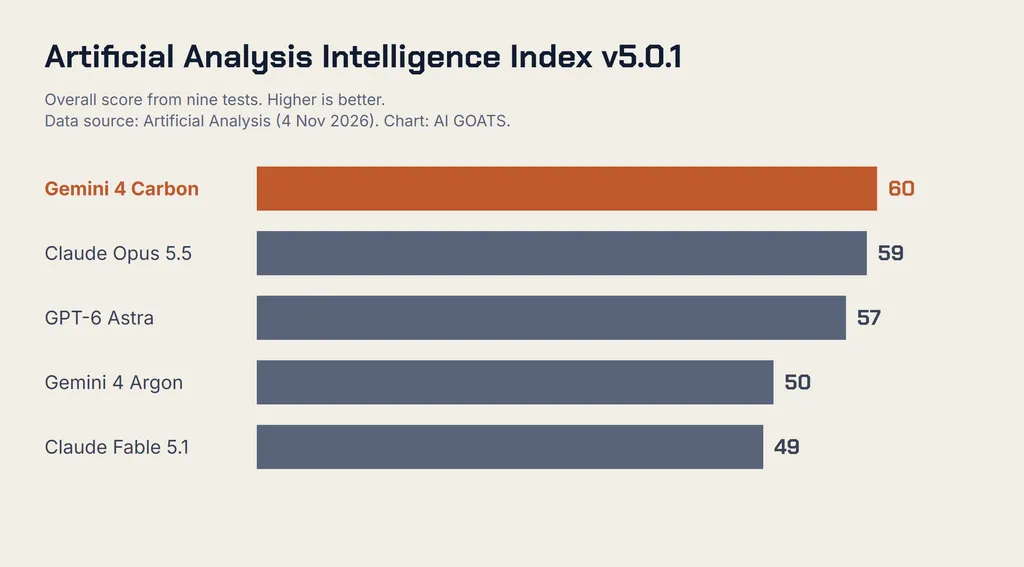
According to The Decoder, Carbon wins four of the nine components, mainly complex reasoning, knowledge retrieval and scientific tasks. Other independent rankings order the top group differently:
| Test | What it checks | Carbon | Best rival |
|---|---|---|---|
| Vals Index | professional tasks, including law and finance | 70.45% (2nd place) | Claude Sonnet 5.5: 70.85% |
| Coding Agent Index (Artificial Analysis) | programming through an AI agent | 59 points | Claude Code with Opus 5.5: 62 points |
| AA-Briefcase | long office tasks: spreadsheets, presentations, memos | 1610 Elo (17th place) | Claude Sonnet 5.5: 1813 Elo |
| OSWorld 2.1 (Google data) | operating a computer independently | 81.5% | Claude Opus 5.5: 87.2% |
| FrontierSWE 2 (Google data) | hard programming tasks | 61.2% | GPT-6 Astra: 65.5% |
The gap in the Vals Index falls within the margin of error, which is 0.97 points for Carbon. AA-Briefcase shows a clear distance in the work that most resembles a day at the office. Claude Sonnet 5.5 and Opus 5.5 sit well above Carbon here, even though it improved on Argon’s result by 126 points.
Where does Carbon beat Claude and GPT-6 Astra?
In several areas Carbon’s lead is larger than the measurement error.
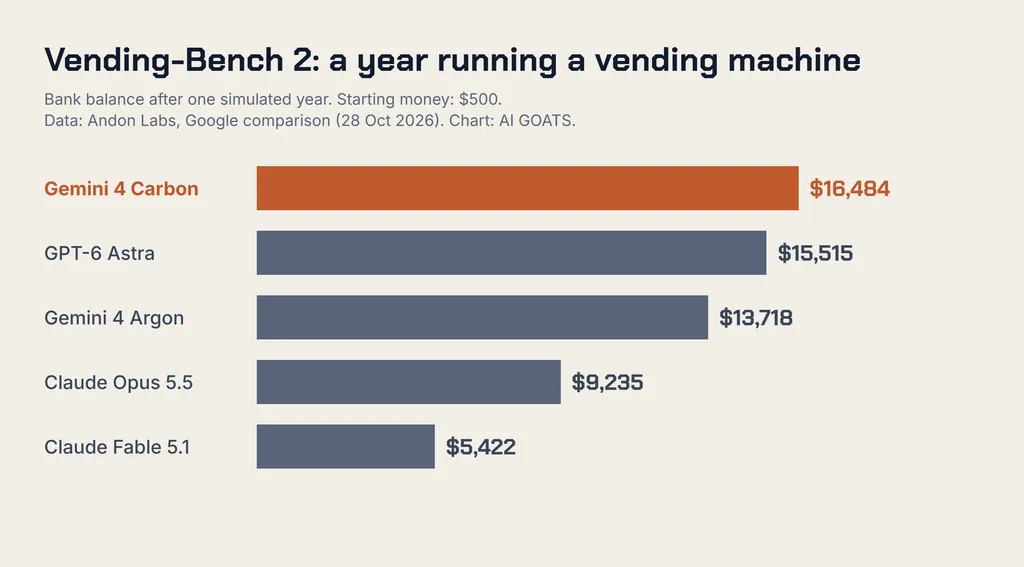
Running a business. In the Vending-Bench 2 test from Andon Labs, a model runs a simulated vending machine for a year. It finds suppliers, negotiates prices, orders stock by email and handles complaints, and suppliers may cheat. Carbon ended the year with 16,484 dollars, the highest amount on the list. The test’s authors estimate that a good strategy could bring in about 63,000, so models are still far from the ideal.
Very long documents. The GraphWalks test makes a model follow connections hidden in text of up to one million tokens, about 1,500 pages. Tokens are the pieces of text you pay for in AI. In Google’s comparison Carbon scored 96.2%, Argon 84.2%, GPT-6 Astra 71.8% and Claude Opus 5.5 66.8%. This is the largest lead in the whole table.
Law and finance. On Vals AI, Carbon is first in the Legal Research Bench (55.77%, 1st of 89 models) and the Vals Finance Index (67.05%, 1st of 35). It pays for this in time: according to The Decoder, one legal research task takes it over 50 minutes on average.
Automation. In AutomationBench from Zapier, a test of automated office tasks, Carbon has 53.9% according to Google’s comparison. GPT-6 Astra scored 41.4% and Claude Opus 5.5 42.5%.
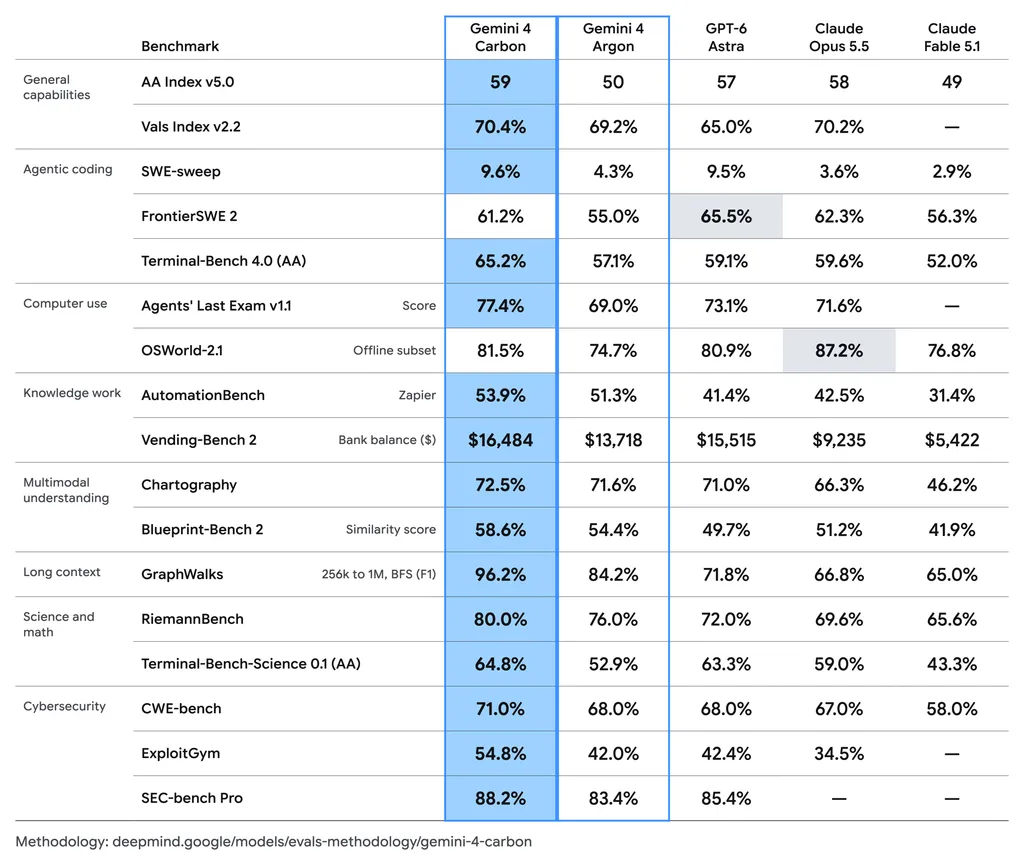
Google put this table together itself, so the maker chose which tests to show. Some results come from independent organisations, though, and Google concedes two rows to rivals.
Why isn’t Google releasing Carbon to everyone?
Google tested Carbon at three stages of defending against an attack. Models first look for a vulnerability, a bug in a program that lets someone break in, then check whether it can be exploited, and finally write a fix.
| Stage | Test | Carbon | Argon | GPT-6 Astra | Claude Opus 5.5 |
|---|---|---|---|---|---|
| Finding a vulnerability | SEC-bench Pro | 88.2% | 83.4% | 85.4% | no data |
| Exploiting it | ExploitGym | 54.8% | 42.0% | 42.4% | 34.5% |
| Writing a fix | CWE-bench | 71.0% | 68.0% | 68.0% | 67.0% |
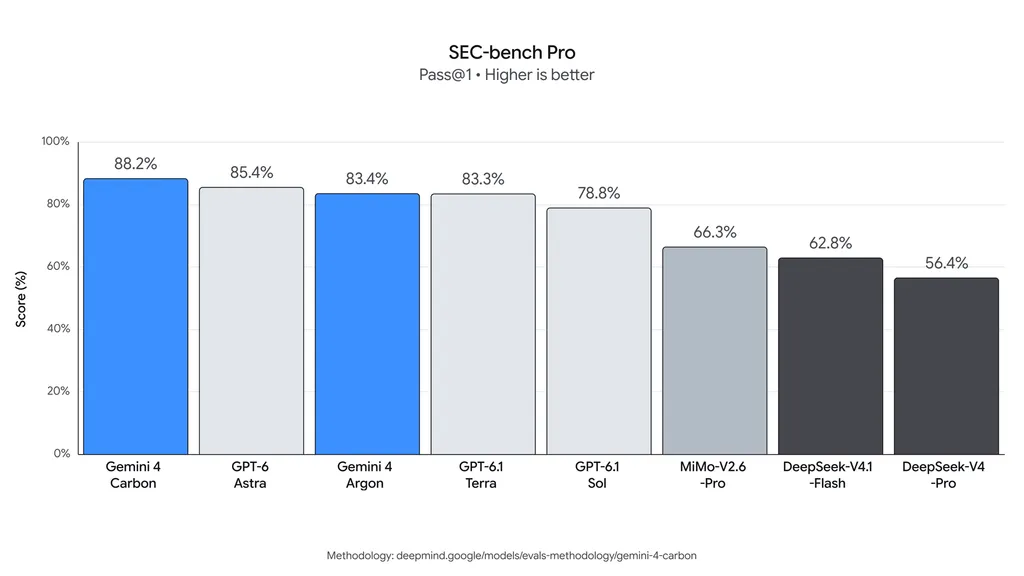
These trials were run without the safeguards customers will get. Google also says the Chrome team rated Carbon’s fixes as more than 10 times better than those from another lab’s large model, but it does not name that model or show figures. Beri points out that the results of these tests come from the maker and have not yet been confirmed independently.
Google writes that it first wants to gather feedback, refine the safeguards and go through the US government’s voluntary pre-release testing. The second of these tests hints at the reason for the caution: a program that checks whether a vulnerability can be exploited helps a defender and, in other hands, a burglar too.
So the model goes first to selected defenders and then to the Fairwind Program. It has over 650 partners, mainly governments, operators in healthcare, telecoms, energy and banking, and large technology platforms. Every application is reviewed, and only security teams get access. An ordinary company may apply, but the programme’s page does not promise acceptance.
Google also reports a result for resistance to hidden commands, known as prompt injection. Someone can hide an instruction on a website, and the model will read and carry it out. In the Gray Swan test no attack on Carbon succeeded (0.0%), while Argon let through 0.7%.
How often does Carbon make things up?
This number surprised us most in the whole announcement. In the AA-Omniscience knowledge test, Carbon answers correctly more often than Argon: 58% against 48%. At the same time its hallucination rate rose from 4% to 11%. This rate shows how often a model gives a wrong answer when it should admit it does not know.
So Carbon knows more, but guesses more readily. Even so, 11% is one of the lowest results in the ranking: only Carbon in its Medium version and Argon are lower, at 4% each. Claude Opus 5.5 and GPT-6 Astra in their strongest versions are at 50% each. The combined knowledge score also favours Carbon: 54 points against 48 for Opus.
Google describes this differently. In its internal tests it reports that Carbon makes about half as many unsupported claims as Argon. That is a different test with different questions, so one number does not cancel the other. Facts, amounts and regulations in a model’s answers still need the same checking as with any other model.
How much will Gemini 4 Carbon cost?
The price list applies to developers who connect the model to their own applications through an API. There is no public access for them yet.
| Per million tokens | Launch price | Price after the introductory period |
|---|---|---|
| Text sent to the model | $2 | $4 |
| Model’s answer | $10 | $20 |
| Text from the cache | 95% less than sent text | 95% less than sent text |
Google has not given an end date for the promotion. Artificial Analysis already uses the higher rate of 4 and 20 dollars. Calculated this way, one task from its test set costs 7.76 dollars. Argon comes to 7.68 dollars, Claude Opus 5.5 to 10.04 dollars and GPT-6 Astra to 6.25 dollars. For the prices of other models, see our article on GPT-6.1 Terra.
In Agent Arena, where people give models real tasks, Carbon took second place behind Claude Opus 5.5 in its Max version. According to The Decoder, a task there has a median cost of 1.80 dollars, 72% less than with Opus.
You also have to allow for waiting. Artificial Analysis measured that in deep reasoning mode the first word of an answer appears after about 65 seconds. The median for models at a similar price is 13.23 seconds. Carbon therefore suits longer jobs better than a quick conversation.
Google has not said which Gemini app plan will include Carbon.
What the videos about Gemini 4 Carbon show
We found over 20 videos on YouTube, but nobody outside the programme has access to the model, so their authors mostly discuss charts. A short video from AI with Surya, lasting under 7 minutes, sums the topic up best: it translates the tests into everyday business situations and says plainly why you can’t use the model yet.
The closest anyone comes to showing the model itself is a comparison described in a video by Jad M.H. An anonymous tester asked an early version of Carbon on the Arena platform and Claude Opus 5.5 to build a 3D helicopter model. Carbon finished after about 30 minutes, Opus after 55. The tester preferred Carbon’s design but rated the Opus version as more polished. The two models ran in different tools and this was not the final version of Carbon, so treat it as a curiosity.
When will Carbon be available to businesses?
Google says this will happen “as soon as possible” and gives no date. Varun Mohan, who is responsible for Google’s programming tool Antigravity, told VentureBeat that wider access through Fairwind comes first, and only then availability in Antigravity itself.
Until then the closest equivalent in Google’s range is Argon, while in office work and programming independent tests point to Claude models. We wrote about another assistant meant to work in the background without constant supervision when covering Claude Duet. If you want to hand long tasks to AI in your company, we describe what deploying AI agents looks like.
Frequently asked questions about Gemini 4 Carbon (FAQ)
Can you buy Gemini 4 Carbon?
No. The model is not in the Gemini app or in a public API. Google has already published a price list, but it applies to developers and will matter once the API opens.
How do you get access to Carbon?
A company can apply to the Fairwind Program. Google reviews every application, and only security teams get access. The programme’s page does not promise acceptance to an ordinary company.
When will Carbon be available to everyone?
Google has not given a date. Its announcement says the model will reach developers, businesses and consumers “as soon as possible”.
How does Carbon differ from Argon?
Argon is already available to developers and companies, while Carbon is closed. In Artificial Analysis Carbon has 60 points and Argon 50. In the AA-Omniscience test Carbon answers correctly more often (58% against 48%), but it also guesses more often (11% against 4%).
Is Carbon better than Claude Opus 5.5?
It depends on the task. Carbon beats Opus by one point in the overall ranking and clearly on very long documents. Opus leads in programming through an AI agent (62 points against 59) and in operating a computer independently (87.2% against 81.5%).
How much text does Carbon hold?
Artificial Analysis and Vals AI list a context window of 1 million tokens, about 1,500 pages. That is how much the model can read at once. Google’s announcement does not mention this number.
Sources
- Google: Gemini 4 Carbon, our next frontier model
- Google DeepMind: Fairwind Program
- Google DeepMind: Gemini 4 safety report
- Artificial Analysis: Gemini 4 Carbon
- Artificial Analysis: AA-Omniscience
- Artificial Analysis: AA-Briefcase
- Vals AI: Gemini 4 Carbon
- Andon Labs: Vending-Bench 2
- The Decoder: Google DeepMind releases Gemini 4 Carbon
- VentureBeat: Google unveils Gemini 4 Carbon
- Beri: Gemini 4 Carbon Tops Artificial Analysis, but Google Limits Access
- AI with Surya: Gemini 4 Carbon, What Google’s New #1 AI Means for Your Work
- Jad M.H.: Gemini 4 Carbon vs Opus 5.5 vs GPT-6 Astra