




Claude Fable 5.2 at a glance
- Release: November 9, 2026, in the Claude apps, in Claude Code and in the API as
claude-fable-5-2(Anthropic). - Price: 8 dollars per million tokens sent to the model and 40 dollars per million output tokens. Fable 5.1 cost 10 and 50 dollars.
- Ranking: 65 points and 1st place out of 74 models in the Artificial Analysis Intelligence Index.
- Cost per task: 26.54 dollars at the highest effort level, 9.08 dollars at high (Artificial Analysis).
- Vendor’s advice: Anthropic recommends starting everyday work with Claude Opus 5.5 and keeping Fable for the hardest tasks.
Claude Fable 5.2 is Anthropic’s most capable publicly available language model, a program that reads and writes text and code. It has a twin, Mythos 5.2, with part of its safeguards lifted for cybersecurity and life sciences work. Mythos goes only to vetted organizations, so this article covers Fable only.
What changed in Fable 5.2 compared with version 5.1?
Anthropic lists four changes in its announcement that an ordinary user will notice.
Speed. According to Anthropic, responses are up to 30% faster than in Fable 5.1. On top of that there is a new fast mode, which writes responses up to 2.5 times faster but costs twice as much: 16 and 80 dollars per million tokens.
Price. According to Anthropic’s pricing, rates dropped by one fifth, from 10 to 8 dollars per million input tokens and from 50 to 40 dollars per million output tokens.
Fewer refusals. According to Anthropic, the model refuses tasks unnecessarily about 55% less often. For cybersecurity questions it is about 60%, and for biology about 40%. The data comes from early testing in claude.ai, Claude Code and Cowork.
Remote work. In Anthropic’s table, the score in the Remote Labor Index, a test of real freelance jobs done remotely, rose from 17.9% to 41.3%. In the same table Opus 5.5 has 21.3% and GPT-6 Astra 20.8%. This is the biggest jump in Anthropic’s whole table.
According to Anthropic’s documentation, the context window, meaning how much text the model handles at once, stays at one million tokens. A response can be up to 128 thousand tokens long.
How much does Claude Fable 5.2 cost compared with Opus 5.5 and GPT-6 Astra?
Tokens are chunks of text you pay for when using AI. Companies quote prices per million tokens, separately for text sent to the model and for its response.
| Model | Text sent (1M tokens) | Response (1M tokens) | Source |
|---|---|---|---|
| GPT-6 Astra | 10 USD | 50 USD | OpenAI |
| Claude Fable 5.2 | 8 USD | 40 USD | Anthropic |
| Claude Opus 5.5 | 4 USD | 20 USD | Anthropic |
| Claude Sonnet 5.5 | 2 USD | 10 USD | Anthropic |
| Claude Haiku 5.5 | 0.10 USD | 0.50 USD | Anthropic |
According to OpenAI’s pricing, GPT-6 Astra costs 10 and 50 dollars, so Fable 5.2 is 20% cheaper per token. It is twice as expensive as Opus 5.5, four times as expensive as Sonnet 5.5 and eighty times as expensive as Haiku 5.5 for text sent to the model. The Haiku price applies to requests up to 100 thousand tokens. For Astra, above 272 thousand tokens the rate rises to 20 and 75 dollars.
The name “Astra 6.1” also appears online. No such model exists in OpenAI’s pricing or in the Artificial Analysis ranking. OpenAI’s most capable model is GPT-6 Astra from September 3, and the 6.1 series includes the cheaper GPT-6.1 Sol and GPT-6.1 Terra.
How does Fable 5.2 perform in the Artificial Analysis ranking?
Artificial Analysis is an independent company that runs the models itself on the same set of nine tests and combines them into one score. In version 5 of the index, Fable 5.2 at the highest effort level scores 65 points and takes 1st place out of 74 models.
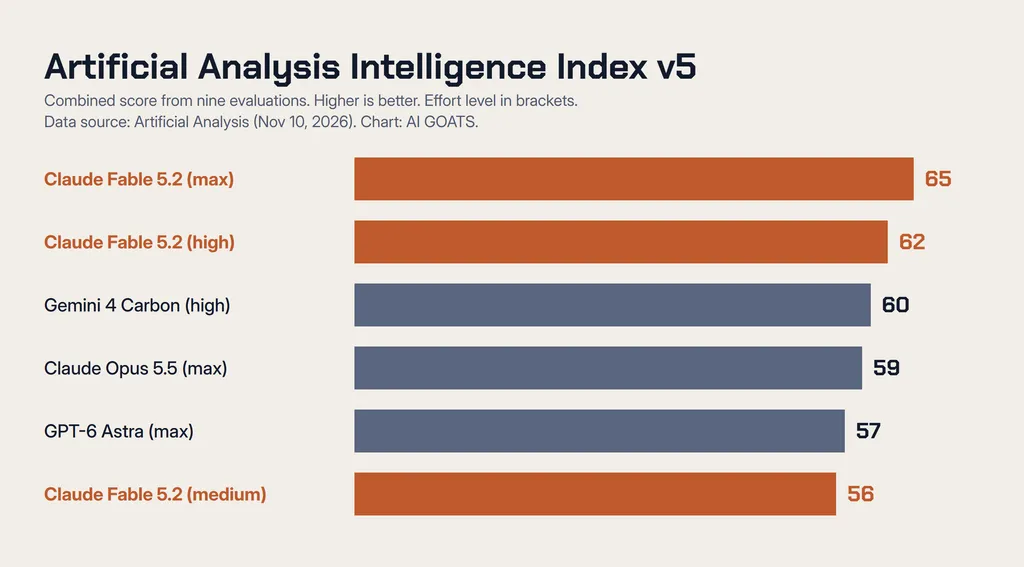
The effort level tells the model how long to think before answering. Fable has five of them: low, medium, high, xhigh and max. At high it already scores 62 points, more than Gemini 4 Carbon (60), Claude Opus 5.5 at max (59) and GPT-6 Astra at max (57). According to The Decoder, Fable 5.1 scored 15 points lower in this index.
According to The Decoder, Fable wins five of the nine components of the index, including Terminal-Bench Science (73%) and FrontierCode 2.0 (49%). In Terminal-Bench 4.0, work in a terminal, it ties with Opus 5.5 (60%), while Gemini 4 Carbon and Claude Sonnet 5.5 score higher. In AA-Briefcase, a test of long office tasks, the results of Fable, Opus 5.5 and Sonnet 5.5 fall within the margin of error.
What do Anthropic’s official tests show?
Anthropic published a table comparing Fable 5.2 with its predecessor and with rivals. Results are from the highest available effort level unless stated otherwise.
| Test | What it checks | Fable 5.2 | Fable 5.1 | Opus 5.5 | GPT-6 Astra | Gemini 4 Carbon |
|---|---|---|---|---|---|---|
| FrontierSWE v2 | hard programming tasks | 69.9% | 56.3% | 62.3% | 65.5% | 61.2% |
| OSWorld 2.1 | operating a computer on its own | 89.3% | 83.5% | 87.2% | 79.5% | 81.5% |
| Humanity’s Last Exam (with tools) | expert questions from many fields | 74.2% | 65.6% | 67.7% | 57.2% | n/a |
| Terminal-Bench Science | science tasks in a terminal | 74.6% | 52.6% | 58.7% | 68.1% | 64.8% |
| AutomationBench | office work automation | 51.4% | 31.4% | 42.5% | 41.4% | 53.9% |
The vendor put the table together, so it chose the tests. One row goes to a rival: in Zapier’s AutomationBench, Gemini 4 Carbon does better. The numbers match those quoted by The Decoder.
Why does one task at max effort cost 26 dollars?
The price per token is only half of the bill. The other half is the number of tokens the model uses before it finishes. At the highest level Fable thinks for a very long time and writes a lot of text along the way that the user never sees.
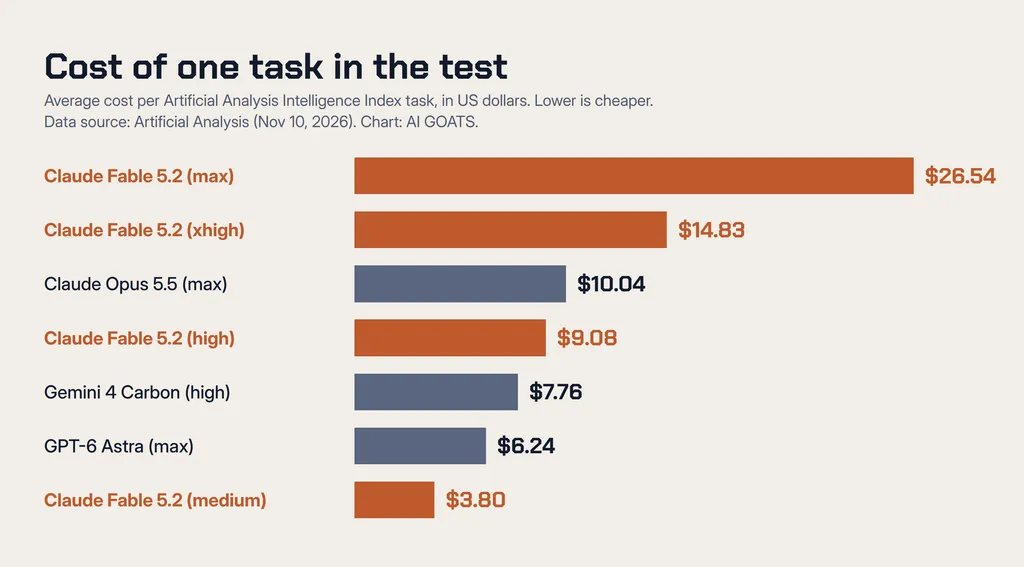
According to Artificial Analysis, across the whole test Fable 5.2 at max generated 275 million output tokens. GPT-6 Astra needed 54 million, about five times fewer. That is why one task cost Fable 26.54 dollars, Opus 5.5 at max 10.04 dollars and Astra 6.24 dollars.
Fable is not slow at writing. Artificial Analysis measured 103 tokens per second, against 37 for GPT-6 Astra. The thinking is what takes long. At max, the first word of the answer appears after 235 seconds on average, and one test task takes 44 minutes. That is the slowest result in the ranking.
Creators’ tests show the same pattern. Mervin Praison compared Fable 5.2 at high with Opus 5.5 at max on three tasks on his channel. Fable completed all three for 0.73 dollars. Opus spent 2.60 dollars and finished one, because in the other two it hit the token limit before writing anything.
The vendor draws a similar conclusion. In the announcement Anthropic writes that in the FrontierCode test Fable 5.2 at high scores about the same as Opus 5.5’s best result for roughly half the cost per task, and above GPT-6 Astra’s best result at about the same cost.
How do you set Fable 5.2’s effort level in Claude Code?
In the Claude apps and in Claude Code, Fable 5.2 works at medium by default. Anthropic says that at this level it handles hard tasks with fewer tokens than Fable 5.1. In Artificial Analysis, medium gives 56 points for 3.80 dollars per task.
You change the level in Claude Code with the /effort command, for example:
/effort highThe available values are low, medium, high, xhigh and max. According to Artificial Analysis data, high comes out best: 62 points for 9.08 dollars. Xhigh gives the same score for 14.83 dollars, and max adds 3 points for almost three times the bill. Mervin Praison and Nikita Jefimov, whose videos we reviewed, advise against max for everyday work.
Anthropic itself advises starting with Claude Opus 5.5 for most coding and knowledge tasks and reaching for Fable on the hardest, open-ended projects. We show how to work in Claude Code step by step in the guide video from one prompt.
Is Fable 5.2 available on the Claude Pro plan?
Yes, for one week. According to the Claude Help Center, Pro plans and standard seats on Team plans include all Fable models until November 16 (11:59 pm Pacific Time). Fable can use at most 50% of the weekly limit. After that, Pro goes back to billing through extra usage credits.
Those who paid before November 9 also get one Fable reset. You use it in Settings, under Usage. The reset gives back the limit spent on Fable and refills the five-hour limit, but it does not raise the limits themselves. Max and Ultra plans get one to three resets depending on how long they have subscribed, valid until March 8, 2027. The Free plan does not include Fable.
The default model does not change. You have to pick Fable manually in the model list, and according to Anthropic it uses up limits faster than other Claude models. We describe how to stretch your Claude limit in the guide 4 ways to handle limits.
Frequently asked questions about Claude Fable 5.2 (FAQ)
How much does Claude Fable 5.2 cost?
According to Anthropic, in the API it costs 8 dollars per million tokens sent to the model and 40 dollars per million output tokens. Fast mode costs 16 and 80 dollars. On the Claude Pro plan Fable is included until November 16, 2026, up to half of the weekly limit.
Is Fable 5.2 better than Opus 5.5?
In the Artificial Analysis ranking, yes: 65 points against 59, and 62 points at high. In Anthropic’s tests Fable wins at programming and operating a computer. It costs twice as much per token, though, which is why Anthropic advises starting everyday work with Opus 5.5.
Is Fable 5.2 better than GPT-6 Astra?
In the Artificial Analysis ranking Fable scores 65 points and GPT-6 Astra 57. Fable is 20% cheaper per token, but at max one task costs more than four times as much, because it uses about five times as many tokens.
Which effort level should you choose in Claude Code?
The default is medium. For hard tasks, Artificial Analysis data points to high (the /effort high command): 62 points for 9.08 dollars per task. Max costs almost three times as much and adds 3 points.
How is Fable 5.2 different from Mythos 5.2?
It is the same model. Mythos 5.2 has part of its safeguards lifted and is available only to vetted organizations in cybersecurity and life sciences. Fable 5.2 is available to all paying users and in the API.
Sources
- Anthropic: Introducing Claude Fable 5.2 and Claude Mythos 5.2
- Claude Platform Docs: What’s new in Claude Fable 5.2
- Claude Platform Docs: Pricing
- Claude Help Center: Claude Fable 5.2 launch offers
- OpenAI: API Pricing
- Artificial Analysis: Claude Fable 5.2
- Artificial Analysis: Claude Fable 5.2 (high)
- Artificial Analysis: Claude Opus 5.5
- Artificial Analysis: GPT-6 Astra
- Artificial Analysis: model leaderboard
- The Decoder: Claude Fable 5.2 and Mythos 5.2 cement Anthropic’s AI lead
- Mervin Praison: Claude Fable 5.2 vs Opus 5.5: What It REALLY Costs