




Gemini 4 Hydrogen at a glance
Gemini 4 Hydrogen is the fast and cheapest model in Google’s Gemini 4 family and the successor to Gemini 3.8 Flash. In the API it costs 1.50 dollars per million input tokens, and in an independent ranking it edges past the pricier Gemini 4 Argon by one point.
- What it is: the successor to Gemini 3.8 Flash, a fast model for everyday work, coding and AI agents (programs that carry out tasks step by step on their own). According to the model card it was built from Gemini 4 Carbon.
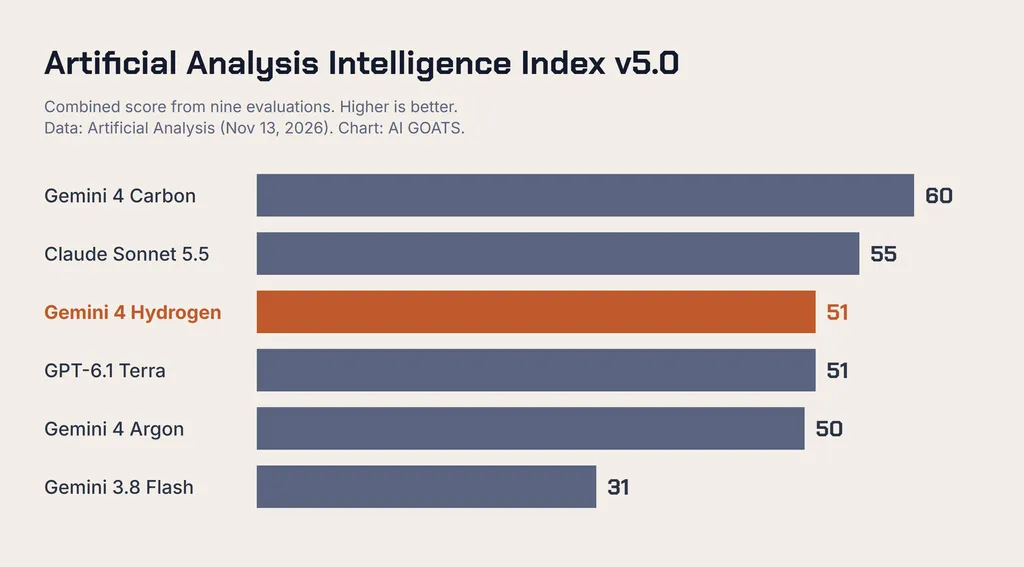
- Score: 51 points in the Artificial Analysis Intelligence Index, one more than Gemini 4 Argon.
- API price: 1.50 dollars per million input tokens and 7.50 dollars per million output tokens, according to the Gemini API price list.
- Cost per task: 1.87 dollars in the Artificial Analysis test, against 7.77 dollars on Gemini 3.8 Flash.
- Where it runs: the default model of AI Mode in Google Search worldwide, the Gemini app, Gemini API, AI Studio, Antigravity.
- Weak spot: according to the model card it refuses safe requests more often than Flash (+5.57 percentage points).
What is Gemini 4 Hydrogen and how is the Gemini 4 family split?
Google DeepMind introduced Gemini 4 Hydrogen on 12 November. In the post by Koray Kavukcuoglu, Google’s chief AI architect, the model is described as a major upgrade for teams moving from Gemini 3.8 Flash. It is the third model in the Gemini 4 family, after Argon and Carbon.
Google splits the family by job:
- Gemini 4 Carbon and Gemini 4 Argon are models for long, multi-step reasoning on the hardest problems.
- Hydrogen is meant to get tasks done fast: write and fix code, call tools, run agents. It can work on its own or as the executor that Carbon or Argon hands a plan to.
The model card says it plainly: “Gemini 4 Hydrogen is adapted from Gemini 4 Carbon”. Hydrogen is therefore a derivative of Google’s strongest model, adapted for faster and cheaper work, not another version of Flash. Google does not disclose how large the model is.
According to the model card, Hydrogen accepts text, images, audio and video and answers in text. Its context window, the amount of text the model sees at once, is one million tokens (a token is a piece of a word that you pay for in AI). An answer is up to 64 thousand tokens by default and up to a million in background mode. The model’s knowledge goes up to March 2026.
A new feature is four thinking levels: low, medium, high (default) and the new xhigh. The higher the level, the longer the model analyses a task and the more tokens it uses.
How does Gemini 4 Hydrogen do in the Artificial Analysis ranking?
Artificial Analysis is an independent company that tests AI models on the same set of nine tasks covering office work, coding, science and general knowledge. At the default thinking level Hydrogen got 51 points and took 21st place out of 78 models. Gemini 4 Argon has 50 points and Gemini 3.8 Flash 31. The ranking is led by Claude Fable 5.2 with 65 points.
| Model (thinking level) | Score | Rank | Time per task | Cost per task |
|---|---|---|---|---|
| Hydrogen (xhigh) | 54 | 16/78 | 13.7 min | $3.16 |
| Hydrogen (high, default) | 51 | 21/78 | 7.9 min | $1.87 |
| Hydrogen (medium) | 41 | 39/78 | 3.7 min | $0.80 |
| Hydrogen (low) | 27 | 60/78 | 1.3 min | $0.29 |
| Gemini 4 Carbon (high) | 60 | 4/78 | 28.4 min | $5.48 |
| Gemini 4 Argon (high) | 50 | 22/78 | 30.0 min | $4.97 |
| Gemini 3.8 Flash (high) | 31 | 54/78 | 14.7 min | $7.77 |
| Claude Sonnet 5.5 (max) | 55 | 13/78 | 34.1 min | $10.02 |
| GPT-6.1 Terra (max) | 51 | 20/78 | 14.6 min | $0.96 |
Source: model pages on Artificial Analysis, Intelligence Index v5.0.1, as of 13 November 2026.
A one-point lead over Argon is a tie in practice. The difference in speed is large, though. In Artificial Analysis measurements Hydrogen writes 179 tokens per second and Argon 65. It finishes a test task in 7.9 minutes, Argon in 30.
A higher thinking level raises the score to 54 points, but a task then takes almost twice as long and costs 3.16 dollars instead of 1.87.
What do Google’s tests show and where do the numbers diverge?
The tests in Google’s announcement are vendor data. The most important result concerns terminal work, that is typing commands in a computer’s text window. In Terminal-Bench 4.1 Hydrogen scores 57% according to Google, and Gemini 3.8 Flash 18.2%. That is more than three times as much. In the same Google table Claude Sonnet 5.5 has 63.9%, as VentureBeat noted.
Other results from Google’s announcement:
| Test | What it checks | Hydrogen’s score |
|---|---|---|
| Terminal-Bench 4.1 | terminal work | 57% (Flash 3.8: 18.2%) |
| HLE-Diamond | hard science questions | 58.8% |
| Agents’ Last Exam v1.1 | agent tasks | 71.6% |
| Multimodal Knowledge Agent | finding knowledge in images and text | 53.4% |
| Vals Tax Agent Bench | tax tasks | 52.3% (1st place) |
| Agent Arena | agent ranking judged by people | 5th place |
Source: Google, vendor data.
According to Google’s results table, reproduced by eesel AI, Hydrogen beats Claude Sonnet 5.5 at automating office tools (AutomationBench-AA: 76.1% vs 71.8%) but loses at operating a computer (OSWorld-2.1: 77.6% vs 83.9%).
Two places where the data differ:
- Legal ranking. Google cites 55.8% and a shared first place in the Vals Legal Research test. The Vals AI page shows 53.85% and 6th place out of 94 models. In the tax test both sides agree on 1st place.
- Speed. Google says Hydrogen finishes tasks 2.5 times faster than Gemini 3.8 Flash. In Artificial Analysis measurements task time fell from 14.7 to 7.9 minutes, about 1.9 times. These are different tests, so both numbers can be true, but the independent measurement is more modest.
How much does Gemini 4 Hydrogen cost in the API?
Prices according to the Gemini API price list, per million tokens:
| Model | Input | Output | Notes |
|---|---|---|---|
| Gemini 4 Hydrogen | $1.50 | $7.50 | flat price across the context window, free tier in the API |
| Gemini 3.8 Flash | $0.75 | $3.75 | until 31.12.2026, from 1.01.2027: $1.50 / $7.50 |
| Gemini 4 Argon | $2.00 | $10.00 | until 30.11.2026, from 1.12.2026: $4.00 / $20.00 |
| Gemini 4 Carbon | $2.00 | $10.00 | until 30.11.2026, from 1.12.2026: $4.00 / $20.00 |
“Thinking” tokens count as output and cost the same as the answer. Reading from the cache costs 0.075 dollars per million tokens, 95% less than regular input. Batch requests are half price. On the free API tier Google may use the data you send to improve its products.
Against the competition Hydrogen sits in the middle. According to Artificial Analysis, GPT-6.1 Terra costs 1 and 5 dollars and Claude Sonnet 5.5 2 and 10 dollars. The cheapest small models, such as Claude Haiku 5.5, cost 0.10 and 0.50 dollars, so according to VentureBeat a Hydrogen token is 15 times more expensive than theirs.
Why did a pricier token give a cheaper task?
Until the end of the year a Hydrogen token costs twice as much as a Gemini 3.8 Flash token. In the Artificial Analysis test, however, a whole task cost 1.87 dollars on Hydrogen and 7.77 dollars on Flash. Flash worked on the task almost twice as long (14.7 minutes vs 7.9) and scored 31 points instead of 51.
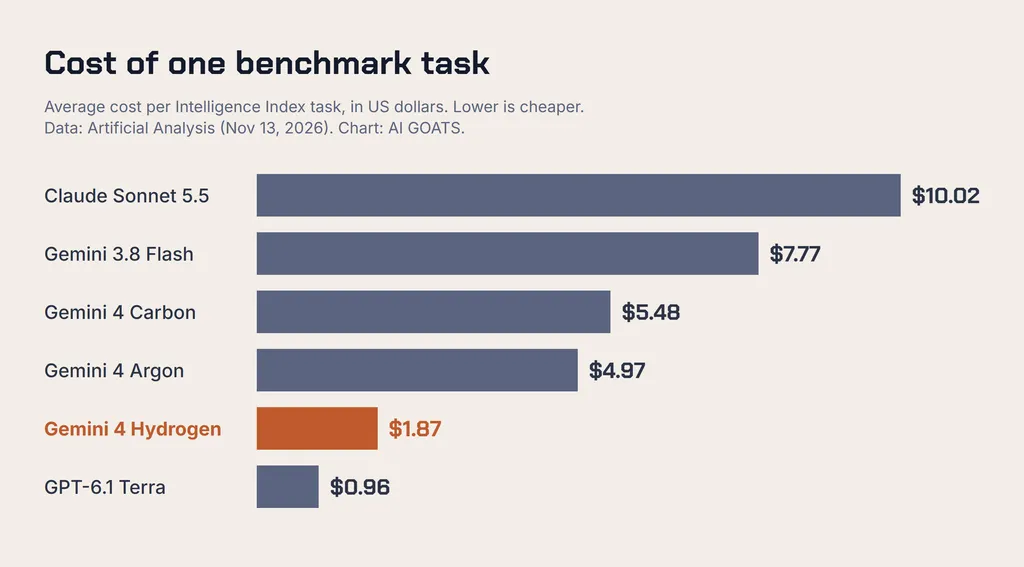
The takeaway for businesses: the token price does not tell you what you will pay for finished work. What counts is how many steps and attempts a model needs to complete a task. From 1 January 2027 Flash will go up to Hydrogen’s price anyway.
Where can you use Gemini 4 Hydrogen?
- Google Search. Hydrogen is the default model of AI Mode for all users worldwide. Robby Stein, VP of Product for Google Search, calls it the biggest model upgrade to Search yet.
- What changes in the answers. AI Mode better understands long, multi-part questions and questions with typos. It splits a question into several searches at once (Google calls this query fan-out) and shows more links, comparison tables and images. AI Mode also works in Polish.
- Gemini app. Paying users pick Hydrogen from the model list. In the Google AI Plus plan it is the main model. Free users cannot choose it manually: they get it only when automatic model selection decides a question is harder. Ordinary questions are handled by Gemini 3.5 Flash-Lite.
- For developers. Gemini API and Google AI Studio (ID
gemini-4-hydrogen), Android Studio and Antigravity on AI Pro and Ultra plans. Antigravity has Orchestrator: Carbon plans and Hydrogen executes. According to Google this gives a result close to Carbon alone while using 24% less quota and working 19% faster. - Google Sheets. Gemini in Sheets with Hydrogen is over 30% faster according to Google. At launch it is available on Pro and Ultra plans.
Does Google’s new model make things up less often?
According to Google, yes. The company says Hydrogen invents facts more than five times less often than Gemini 3.8 Flash. As an agent it should less often do things nobody asked for (down by up to 81%) and less often leave tasks unfinished (up to 79%). In a test of resistance to hidden instructions in content (Gray Swan) it is said to be 2.3 times more resilient. These are results of Google’s internal tests. There is no independent measurement of fabrication yet.
The model card also shows a regression. Hydrogen refuses requests that are safe more often than Flash: the rate of unjustified refusals rose by 5.57 percentage points, especially for prompts with images. Google writes in the card that the model may also make things up, sometimes run slowly and use more tokens at higher thinking levels. The full safety report is due in the coming days.
What are the catches with Gemini 4 Hydrogen?
- Verbosity at the top level. At xhigh Hydrogen used 304 million tokens in the Artificial Analysis test, against a median of 72.8 million. That is 76th place out of 77 models for verbosity, and every token is billed.
- xhigh does not always help. According to VentureBeat, in the Terminal-Bench 4.0 coding test run by Artificial Analysis Hydrogen scored 54% at both high and xhigh. The cost per task rose from 1.87 to 3.16 dollars.
- A competitor with the same score. GPT-6.1 Terra also has 51 points in the Artificial Analysis ranking, and a task costs 0.96 dollars, half as much. Terra is slower, though: a task takes 14.6 minutes and the answer starts after almost three minutes.
- Changes for developers. According to eesel AI and Google’s documentation, the default thinking level is now high (it was medium on Flash), so the bill grows if you do not set it yourself. The minimal level returns an error. There is no manual cache management, and the temperature, top_p and top_k settings are ignored.
Frequently asked questions about Gemini 4 Hydrogen (FAQ)
Is Gemini 4 Hydrogen free?
In AI Mode in Google Search everyone uses it at no cost. The Gemini API has a free tier in which Google may use your data. In the Gemini app free users get it only automatically, for harder questions.
How does Gemini 4 Hydrogen differ from Gemini 3.8 Flash?
In the Artificial Analysis ranking it has 51 points instead of 31, and in Google’s terminal test 57% instead of 18.2%. It was built from Gemini 4 Carbon, thinks longer by default (high level) and has the new xhigh level. A token costs twice as much as on Flash at its promotional price, but a test task came out more than four times cheaper.
Is Gemini 4 Hydrogen better than Gemini 4 Argon?
In the Artificial Analysis ranking it has 51 points and Argon 50, so it is a tie. Hydrogen finishes a task almost four times faster (7.9 vs 30 minutes) and cheaper (1.87 vs 4.97 dollars). Google still recommends Argon and Carbon for the hardest, long problems.
How much does Hydrogen cost in the API?
1.50 dollars per million input tokens and 7.50 dollars per million output tokens, thinking tokens included. The price is the same across the whole million-token window. Batch mode costs half.
When is the xhigh level worth turning on?
Only for tasks where a few points of quality are worth an almost twice as high bill. In the Artificial Analysis ranking xhigh gives 54 points instead of 51 but uses almost three times as many tokens, and in the Terminal-Bench 4.0 coding test it did not improve the score.
What changes in Google Search?
AI Mode answers with the new model. According to Google it better understands questions made of several parts, builds comparison tables more often and shows more links to websites. The change works right away, with nothing to switch on.
Sources
- Google, “Introducing Gemini 4 Hydrogen”
- Google, “Google Search gets a major upgrade with Gemini 4 Hydrogen”
- Google DeepMind, model card
- Google, Gemini API price list
- Google Antigravity, “Gemini 4 Hydrogen and Orchestrator”
- Artificial Analysis, model page (high)
- Artificial Analysis, Intelligence Index
- Vals AI, model page
- VentureBeat, “Google launches Gemini 4 Hydrogen — a faster, smarter, pricier Flash successor”
- Search Engine Journal, the new model in AI Mode
- Notebookcheck, “Gemini 4 Hydrogen: What free users and Google AI Plus get”
- eesel AI, “Gemini 4 Hydrogen review”
- PurePC, “Tańszy model Google pokonał droższego Argona”