




What can the new Gemini 4 Argon model do?
According to Google, the new model can write answers up to one million tokens long. Tokens are small pieces of text that AI uses to build words and sentences. Earlier versions of the model could produce at most 64,000 tokens in a single answer. A longer answer lets the model solve complex tasks without stopping halfway.

The limit of one million tokens covers both what the model reads and what it writes back. It is as if a thick book could fit into one conversation. Google gives examples from its own work: with Argon’s help, engineers rebuilt about 6 million lines of code of the Chrome browser in a few weeks instead of many months, and scientists designed 5 new enzymes in a few hours (a lab confirmed that they work). At Isomorphic Labs, a process that usually took weeks was cut down to hours.
Official results in comparison tests
Google published a table with the results of 19 tests of knowledge and skills on the Google DeepMind website. In the tech world, such tests are called benchmarks. The results show the percentage scores each AI model earned. Gemini 4 Argon won 14 of the 19 tests, including one tie with a competitor.
The table below shows a detailed breakdown of the results published by the maker.
| Test (Benchmark) | Gemini 4 Argon | GPT-6 Astra | Claude Fable 5.1 | Claude Opus 5.5 | Test leader |
|---|---|---|---|---|---|
| Vals Index (knowledge and office work) | 68.9% | 63.1% | 65.8% | 67.0% | Gemini 4 Argon |
| AutomationBench (Zapier) | 51.3% | 41.4% | 31.4% | 42.5% | Gemini 4 Argon |
| Vals Finance Agent v2 (finance) | 65.4% | 53.5% | 58.9% | 58.6% | Gemini 4 Argon |
| Harvey’s Legal Agent Benchmark (law) | 19.6% | 5.4% | 6.7% | 3.8% | Gemini 4 Argon |
| DeepSWE v1.1 (programming) | 77.9% | 74.1% | 67.4% | 74.2% | Gemini 4 Argon |
| FrontierSWE v2 (programming) | 55.0% | 65.5% | 56.3% | 62.3% | GPT-6 Astra |
| Vibe Code Bench (programming) | 91.9% | 89.6% | 90.3% | 90.3% | Gemini 4 Argon |
| Terminal-bench 4.0 (terminal) | 57.4% | 58.2% | 57.9% | 66.4% | Claude Opus 5.5 |
| PostTrainBench (ML engineering) | 45.3% | 44.3% | 40.2% | 49.3% | Claude Opus 5.5 |
| Terminal-Bench Science 0.1 (science) | 57.6% | 68.1% | 52.6% | 63.3% | GPT-6 Astra |
| LABBench 2 (biology) | 88.8% | 85.4% | 68.6% | 73.1% | Gemini 4 Argon |
| RiemannBench (math) | 76.0% | 72.0% | 65.6% | 69.6% | Gemini 4 Argon |
| GraphWalks (up to 128k tokens) | 99.7% | 98.7% | 91.4% | 90.6% | Gemini 4 Argon |
| GraphWalks (256k–1M tokens) | 84.2% | 71.8% | 65.0% | 66.8% | Gemini 4 Argon |
| Agent’s Last Exam (computer use) | 39.5% | 34.2% | — | 38.2% | Gemini 4 Argon |
| OSWorld-2.0 (offline computer use) | 69.2% | 72.6% | — | — | GPT-6 Astra |
| Chartography (reading charts) | 71.6% | 71.0% | 46.2% | 66.3% | Gemini 4 Argon |
| LVBench (understanding video) | 91.7% | 87.5% | 79.7% | 83.7% | Gemini 4 Argon |
| CWE-bench v1 (cybersecurity) | 68.0% | 68.0% | 58.0% | 67.0% | Tie (Argon and Astra) |
The model lost in 5 tests. GPT-6 Astra did better in FrontierSWE v2, Terminal-Bench Science and OSWorld-2.0. Claude Opus 5.5 won the Terminal-bench 4.0 and PostTrainBench tests.
Using Gemini 4 Argon in robotics

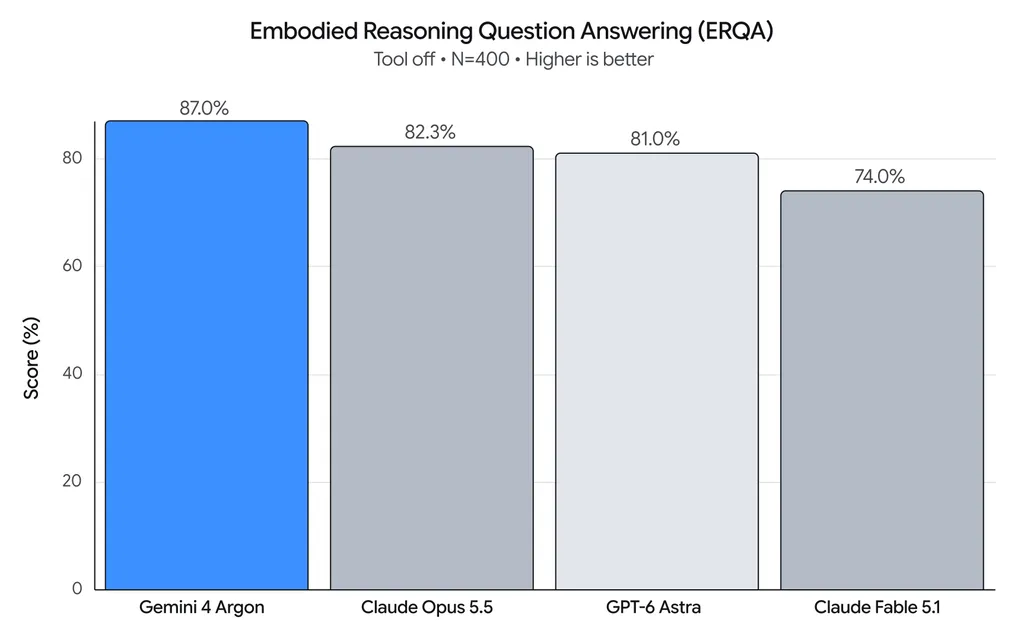
The new model also helps control physical machines. In the ERQA test, the model scored 87.0%. This test checks how well a model understands the space around it and the laws of physics.
Google says that thanks to the new software, the success rate of machines in the real world rose from 56% to 75%. The time needed to finish a task dropped from 35 seconds to 24 seconds. During a demo, the Apollo humanoid robot, which learned a game from a video, hit the target with a bean bag 7 times in a row.
Safety and protection against attacks
According to Google, the model is harder to fool with tricky prompts and deception attempts. In a test by the Gray Swan organization, hacking attacks on this model succeeded only 0.7% of the time. Rule violations happened almost 2 times less often than in older Gemini versions.
Google also launched a special Fairwind program. Through it, cybersecurity experts get access to the model with the usual safety blocks lifted. This helps them find and fix security holes in software in a safe way.
Independent rankings and user criticism
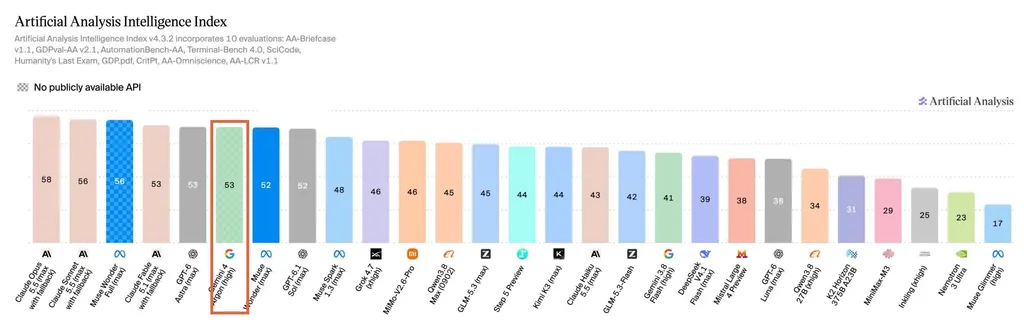
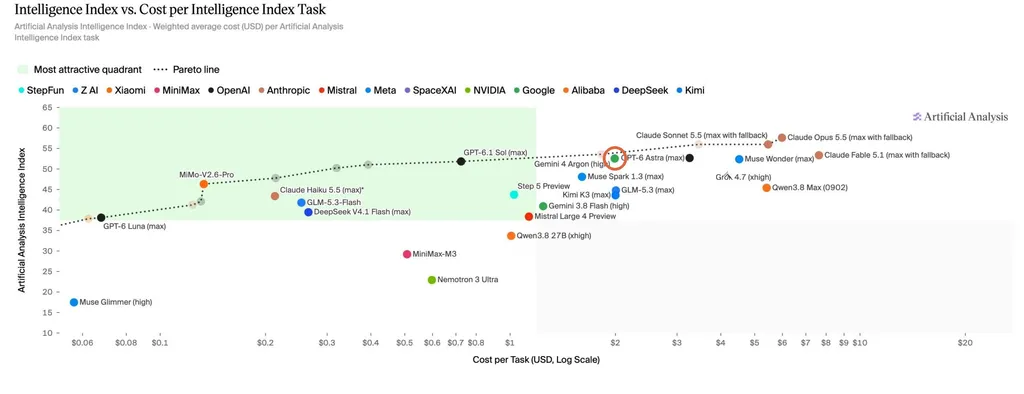
The independent organization Artificial Analysis gave the model 53 points on its intelligence index. Higher scores went to Claude Opus 5.5 (58 points), Claude Sonnet 5.5 (56 points) and Muse Wonder Full (56 points). According to Artificial Analysis data reported by The Decoder, running one test task on Argon costs about $1.99 (on Claude Opus 5.5, about $5.98).
The model stands out for its low level of hallucinations. A hallucination in AI is when a model makes up wrong information and presents it as true. According to The Decoder, the rate of such errors in Gemini 4 Argon is 15%, the lowest among the top models. However, MindStudio points out that this number comes from Google’s own materials, not from an independent check. MindStudio also reports that the model took 1st place in the Arena AI user vote (a subjective rating), but in the WebDev Arena website-building test it was only around 8th. The same site quotes Bloomberg reports that in everyday company work, the model performs worse than in tests.
Pricing and availability
Developers can connect the model to their own apps through an API. An API is a digital link that lets different programs exchange data. The promotional price is $2 per million input tokens and $10 per million output tokens. Input tokens are the text sent to the AI, and output tokens are the answer the model writes.
Using the cache is 95% cheaper. From November 30, 2026, prices will rise to $4 for input and $20 for output. Regular users can find Argon in the Gemini app and in Google Search’s AI Mode, but only on the paid Google AI Pro and Ultra plans. Developers can try it in Google AI Studio. Google is also inviting 10,000 scientists to use the top Antigravity plan for free for 6 months, after applying and being selected.
Sources
- Google, Gemini 4 Argon is now available for everyone, blog.google
- Google, Introducing Gemini 4 Argon (September 30, 2026), blog.google
- Google DeepMind, Gemini results table, deepmind.google/models/gemini
- Google DeepMind, Gemini 4 Argon testing methodology, deepmind.google
- Google Developers Blog, Gemini 4 Argon for Robotics, developers.googleblog.com
- Artificial Analysis, Intelligence Index, artificialanalysis.ai
- The Decoder (Artificial Analysis data), the-decoder.com
- MindStudio, Gemini 4 Argon Benchmarks: How It Really Stacks Up Against Rivals, mindstudio.ai
- VentureBeat, Google makes Gemini 4 Argon broadly available, venturebeat.com