




Two new models from Meta Superintelligence Labs
Engineers from the Meta Superintelligence Labs group built two new language models. An AI language model is a computer model trained to understand and generate text. The smaller model is called Muse Wonder, and the larger, more advanced one is Muse Wonder Full.
Both versions can process 1 million tokens in a single context window. The context window is the amount of information the AI remembers in one conversation. Tokens are small pieces of text that words are made of. You can send the model text, photos and video recordings (Meta says to check audio support on each specific platform). The answers the system generates are text only.
New features: active memory and active focus
The maker added two main features to the new series. The first is active memory (Active Memory). It lets the model remember important facts from earlier conversations and use them when they become useful.
The second is active focus (Active Focus). This feature helps the AI work on long and complicated tasks. When the model runs into a problem, it tries other ways to solve it and asks the user for details before taking important steps.
Official performance test results
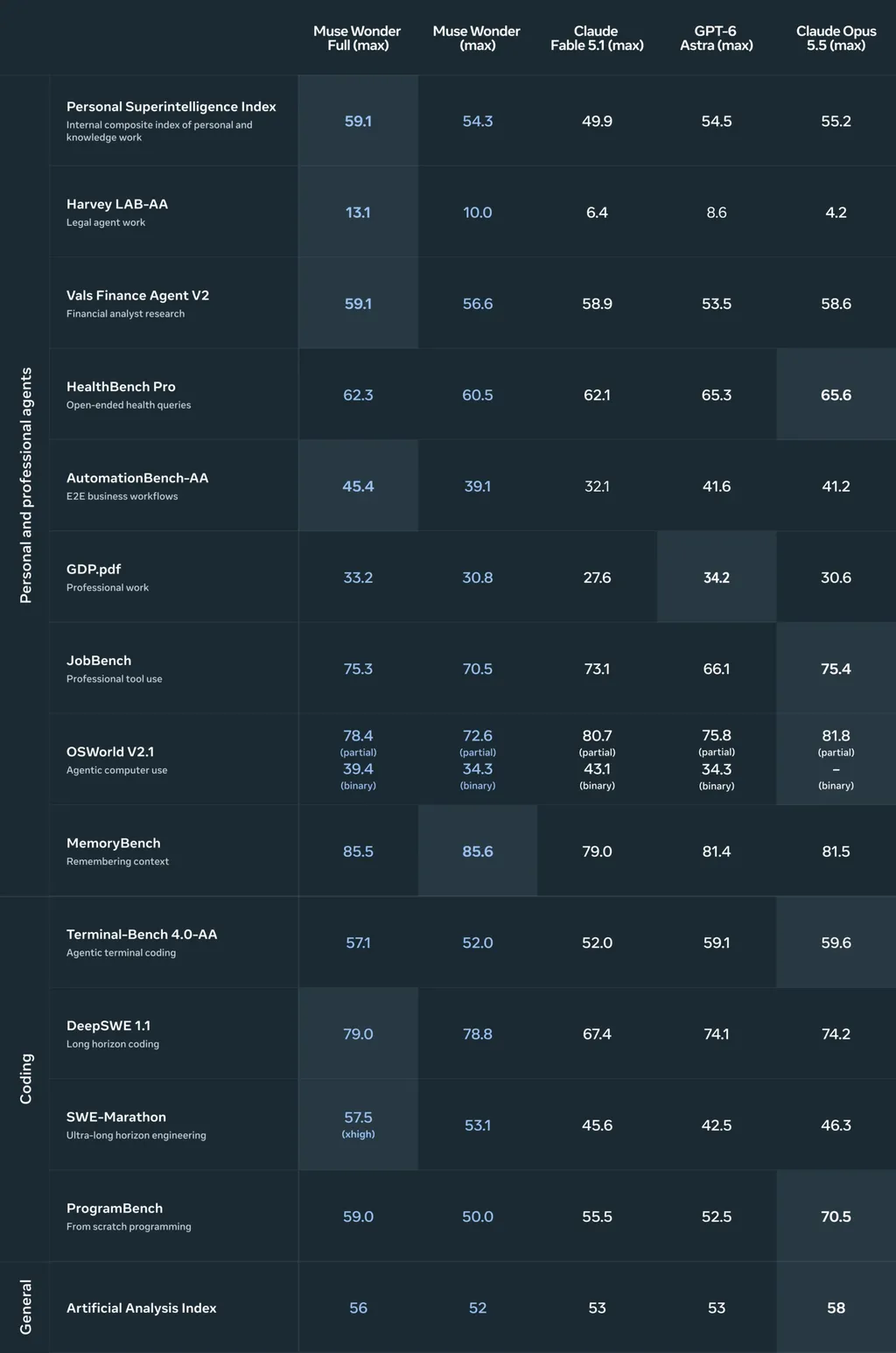
Meta published its own table of test results. These tests are called benchmarks, and they are special tests that compare what AI models can do. The table below shows the Muse Wonder models next to the competition at maximum reasoning effort. The results are points in each test, not percentages.
| Technology test | Muse Wonder Full (max) | Muse Wonder (max) | Claude Fable 5.1 (max) | GPT-6 Astra (max) | Claude Opus 5.5 (max) |
|---|---|---|---|---|---|
| Personal Superintelligence Index | 59.1 | 54.3 | 49.9 | 54.5 | 55.2 |
| Harvey LAB-AA (legal) | 13.1 | 10.0 | 6.4 | 8.6 | 4.2 |
| Vals Finance Agent V2 (finance) | 59.1 | 56.6 | 58.9 | 53.5 | 58.6 |
| HealthBench Pro (health) | 62.3 | 60.5 | 62.1 | 65.3 | 65.6 |
| AutomationBench-AA (business) | 45.4 | 39.1 | 32.1 | 41.6 | 41.2 |
| GDP.pdf (professional work) | 33.2 | 30.8 | 27.6 | 34.2 | 30.6 |
| JobBench (tools) | 75.3 | 70.5 | 73.1 | 66.1 | 75.4 |
| OSWorld V2.1 (computer, partial) | 78.4 | 72.6 | 80.7 | 75.8 | 81.8 |
| MemoryBench (memory) | 85.5 | 85.6 | 79.0 | 81.4 | 81.5 |
| Terminal-Bench 4.0-AA (terminal) | 57.1 | 52.0 | 52.0 | 59.1 | 59.6 |
| DeepSWE 1.1 (long coding) | 79.0 | 78.8 | 67.4 | 74.1 | 74.2 |
| SWE-Marathon (very long projects) | 57.5 | 53.1 | 45.6 | 42.5 | 46.3 |
| ProgramBench (building from scratch) | 59.0 | 50.0 | 55.5 | 52.5 | 70.5 |
| Artificial Analysis Index | 56 | 52 | 53 | 53 | 58 |
According to Meta’s official data, Muse Wonder Full won, among others, the DeepSWE 1.1 long programming test (79.0 points) and the Harvey LAB-AA lawyer work test (13.1 points versus 4.2 points for Claude Opus 5.5, which is more than three times as much). It lost, however, on health questions (HealthBench Pro) and on programming from scratch (ProgramBench).
Independent rankings and hallucinations
The independent research company Artificial Analysis ran its own tests. In its main ranking (Artificial Analysis Intelligence Index v4.3.2), Muse Wonder Full scored 56 points. Claude Sonnet 5.5 got the same score, and the basic Muse Wonder got 52 points (its predecessor, Muse Spark 1.3, had 48 points).
According to The Decoder, Meta’s models did worse than their competitors in general knowledge tests (AA-Omniscience). Muse Wonder Full got 30 points, while Claude Opus 5.5 reached 46 points and GPT-6 Astra 43 points. One strength of the model is its low hallucination rate. A hallucination is when an AI makes up false information and presents it as fact. Muse Wonder Full’s error rate dropped to 23%, the second-best result among the top models after Gemini 4 Argon (15%).
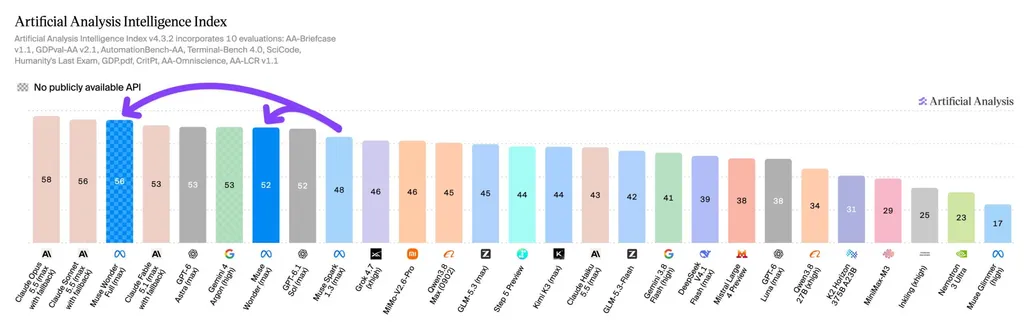
The Decoder also reports that in the Vals AI ranking, Muse Wonder Full took 5th place and beat all OpenAI models. The basic Muse Wonder came in 10th. In the ProofBench math tests, the new version solved 94 out of 100 problems (the previous model solved 58 out of 100).
Pricing and fees for using the models
The basic Muse Wonder model is available through a paid API. An API is a programming interface, a connector that lets software talk to the AI. The cost is $4 per million input tokens (data sent to the AI) and $20 per million output tokens (answers generated by the AI). The earlier Muse Spark 1.3 model cost $1.25 for input and $4.25 for output.
The larger Muse Wonder Full model has no public API. You can use it only through a paid subscription in the Muse Code app, on the Power Usage and Maximum Usage price tiers.
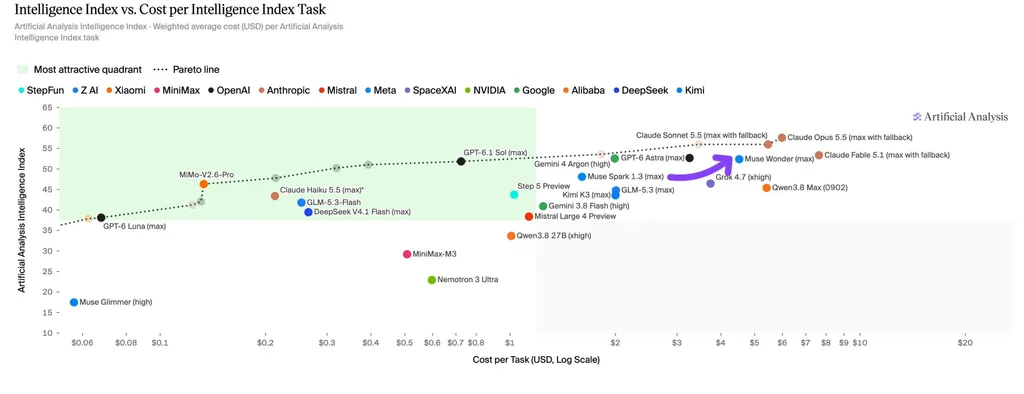
According to Artificial Analysis calculations, the average cost of completing a single task with Muse Wonder is about $4.52. For comparison, a task costs $5.98 with Claude Opus 5.5, $3.26 with GPT-6 Astra and $1.99 with Gemini 4 Argon.
Limit problems and the AI chief’s response
According to MindStudio, access to Muse Code is split into plans that cost $15, $50 and $200 per month. The cheapest plan does not give access to the stronger Muse Wonder Full.
According to MindStudio, problems with the service appeared right after launch. One user on the $50 plan used up the request limit after about 3 minutes and got error 429 (a code that means too many requests in a short time). The problem came back even after switching to the most expensive $200 plan.

MindStudio reports that Meta’s head of AI, Alexandr Wang, responded publicly that the limit issue is known and a fix is in progress.
Safety and resistance to cyberattacks
According to SiliconANGLE, Meta ran safety tests before releasing the models. In the ExploitGym cyberattack resistance tests, Muse Wonder Full captured 92 flags (points for breaking through security). A review showed that 21 flags were captured through an intended gap in the system and 71 through other weaknesses.
In goal misalignment tests (agentic misalignment, a test of whether the computer will take harmful actions to prevent itself from being shut down), Muse Wonder Full scored 0% harmful behavior.
Sources
- Meta Newsroom, Introducing Muse Wonder and Muse Wonder Full, about.fb.com
- Meta AI Research Blog, Muse Wonder: A Frontier Model For Personal & Professional AI Agents, research.meta.ai
- Meta AI Research, Muse Wonder Model Card, research.meta.ai
- Meta AI Developers, Put your ideas to work with Muse Wonder, dev.meta.ai
- Artificial Analysis, Intelligence Index, artificialanalysis.ai
- The Decoder, Meta’s new frontier model Muse Wonder Full breaks into the AI top tier, the-decoder.com
- MindStudio, Muse Wonder Pricing Explained, mindstudio.ai
- SiliconANGLE, Meta releases Muse Wonder AI models, siliconangle.com