




Launched as a test version
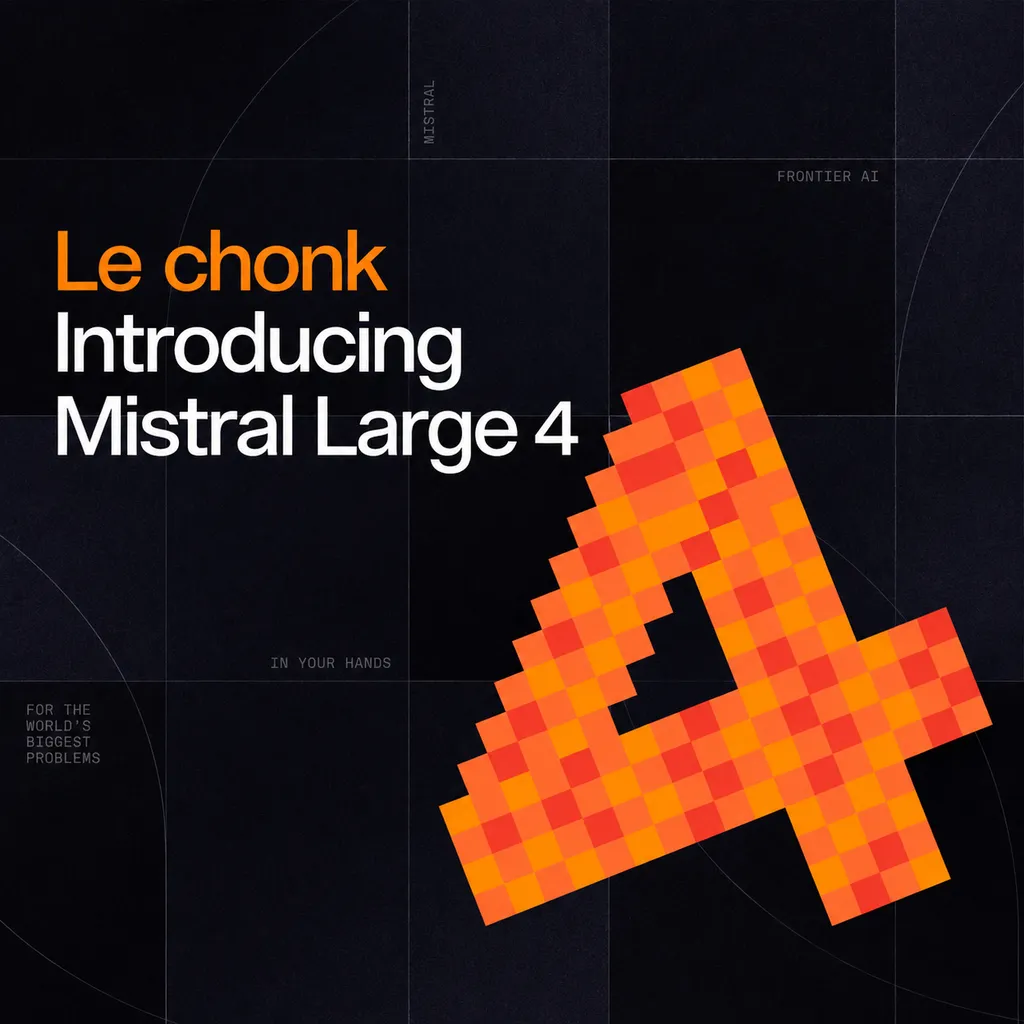
A public test version of Mistral Large 4 has been available since October 6. In its announcement, the company jokes that the model is unofficially called ML4 and, “very officially”, Le Chonk. For now, it can only be used through the API in the Mistral Studio service. An API is a connection that developers use to plug a model into their own apps.
Mistral said it will publish the open weights by the end of October. Weights are the files that hold the model’s “knowledge”. Anyone who has them can run the model on their own servers. According to Airtics, the model’s page on Hugging Face shows the date October 31, 2026. The license terms have not been announced yet.
A trillion parameters and a mixture of experts
According to Mistral, the model has 1 trillion parameters, and 52 billion of them work at each step. Parameters are numbers that the model sets while it learns. MarkTechPost gives more precise figures: 1.05 trillion parameters and 49 billion active ones.
This design is called a mixture of experts. The model works like a large company with many specialists. For each word, only a few of them are called in to work, and the rest wait. Thanks to this, the model is huge, but each word takes less computing.
Mistral Large 4 understands text and images, and it answers in text. According to Artificial Analysis, you can now send 100 images in one request. Earlier Mistral models accepted 8 at most.
The context window is the amount of text a model can read at once. Artificial Analysis lists 512,000 tokens, which are small pieces of text. Some media write about a million tokens. Mistral itself did not give this number in the announcement.
Trained in Europe
Mistral says it trained the model from scratch on 3,800 NVIDIA Grace Blackwell GPUs in its own data centers in Europe. The test version now runs on the same hardware. A large part of the training data was multilingual. The model knows more than 160 languages, including all official languages of the European Union.
The model is set to be available in many regions of the world. One version will run in Europe, fully operated by Mistral and subject to European law. For companies that do not want to send data outside the EU, this is important information.
The score in the Artificial Analysis ranking
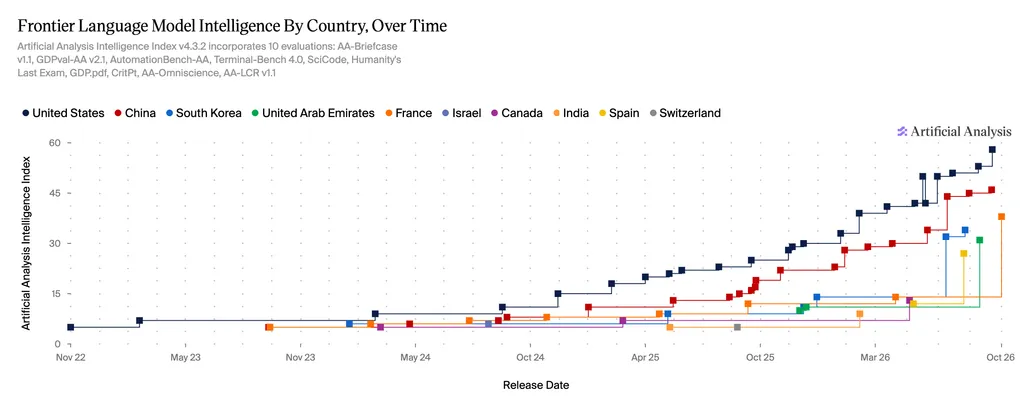
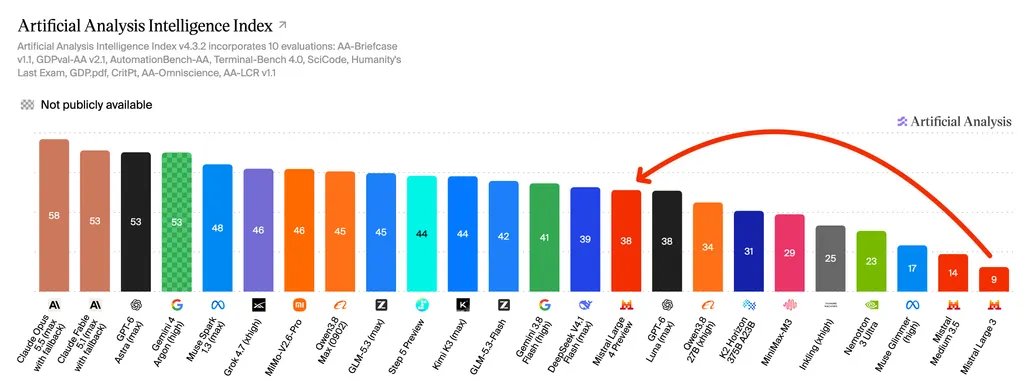
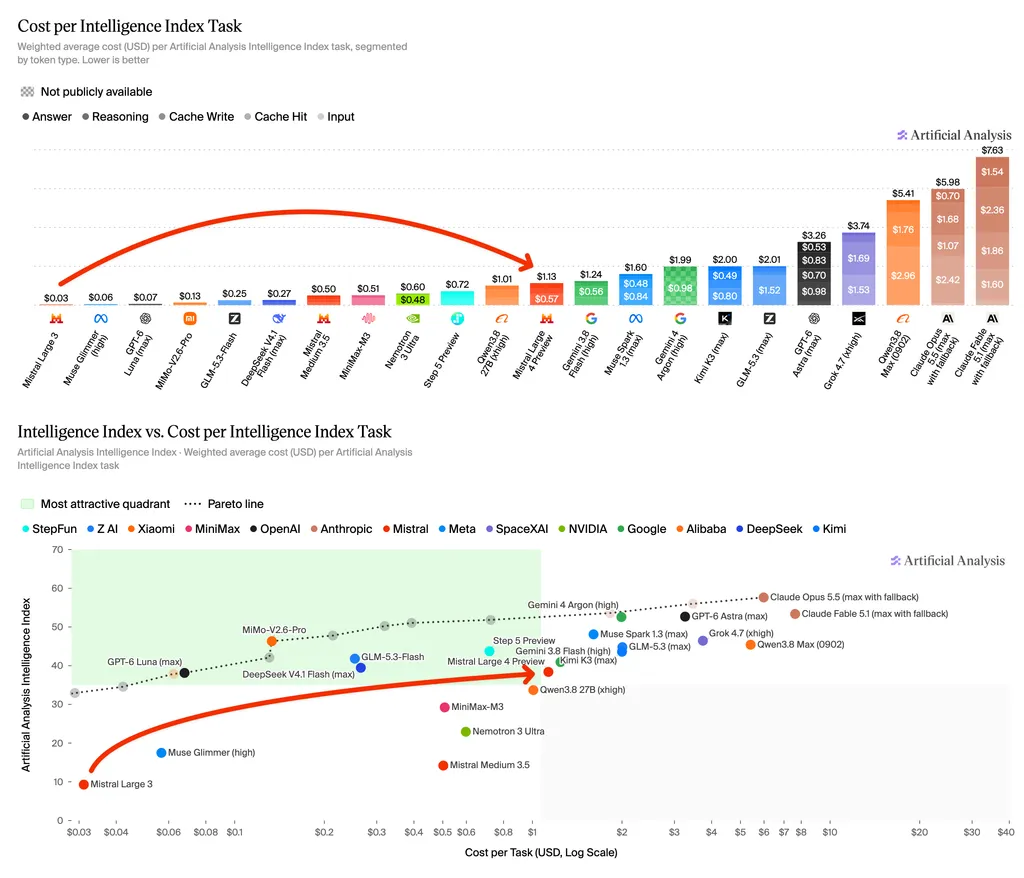
The independent research company Artificial Analysis gave the model 38 points in its intelligence index. On the model’s page, this means 65th place out of 216 models. Artificial Analysis points out that it is the best model made outside the US and China.
The score is similar to DeepSeek V4.1 Flash (39 points) and GPT-6 Luna (38 points). Chinese models with open weights rank higher: Kimi K3 (44), GLM-5.3 (45) and MiMo-V2.6-Pro (46). In the overall ranking, Mistral Large 4 sits in the middle of the pack.
Cybersecurity: a top score and weaker tests
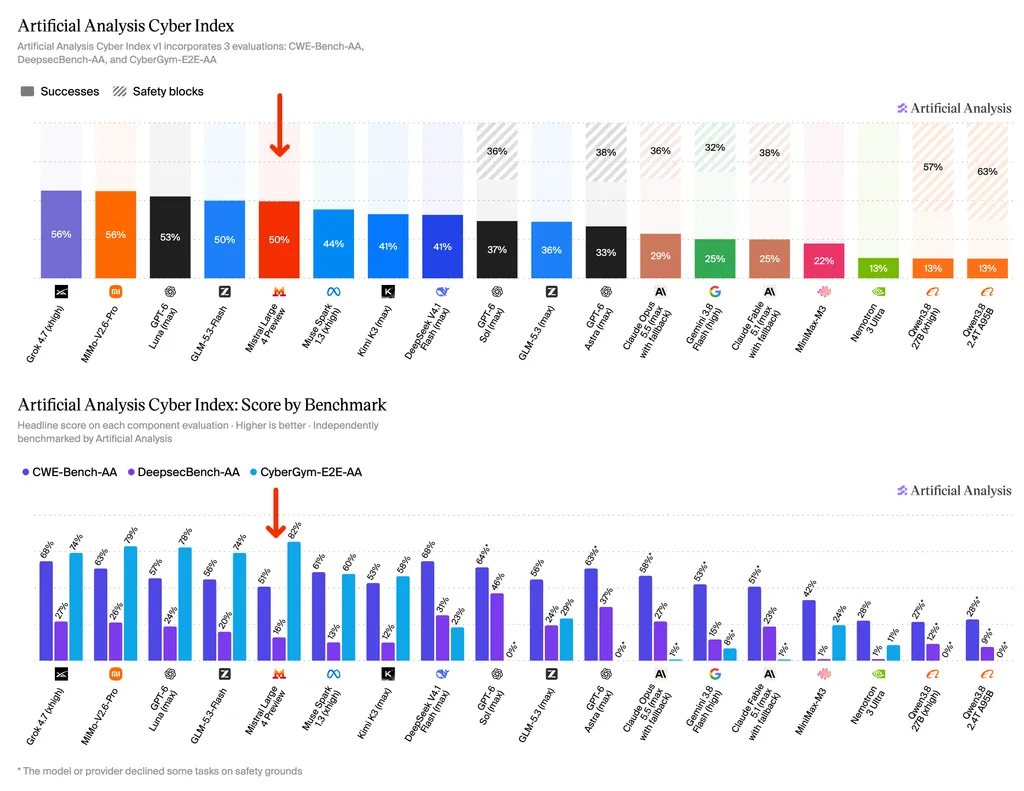
Mistral is especially proud of its cybersecurity results. In the Artificial Analysis cybersecurity index, the model has 50 points. It did best in the CyberGym-E2E-AA test, where it solved 82% of the tasks. This is the best score in that test, ahead of MiMo-V2.6-Pro (79%) and GPT-6 Luna (78%).
It did worse in other parts of this index. Tom’s Hardware points to 16% in DeepsecBench-AA and 51% in CWE-Bench-AA.
Mistral explains why cybersecurity matters to it. Closed models often refuse to help find security holes, even when a qualified specialist is doing the work. Open weights let a company run the model in-house, on its own rules.
The company also shares results from its own measurements: 93% in the Cybench cybersecurity test, 61.7% in the DeepSWE coding test and about 27–28% in Terminal-Bench 4.0. In a blind coding test by Surge AI, ordered by Mistral, the model scored 3.74 out of 5 points. That is 2nd place out of 5 models, behind Claude Opus 5 (4.22). These numbers come from the maker.
Price per token and the real cost of a task
Mistral set the price at $1.36 per million tokens sent to the model and $4.18 per million tokens of output. Tokens stored in the cache cost $0.14 per million. According to Artificial Analysis, this is less than the market median, which is $2 and $10. For the first two weeks, there is a 50% discount ($0.68 and $2.09).
However, Artificial Analysis noticed that the model writes very long answers. In its tests, Mistral Large 4 generated 200 million tokens, while the median is 85 million. A longer answer means a higher bill.
That is why one task from the index costs $1.13 on average, or $0.57 with the discount. That is more than 4 times as much as similarly intelligent models GLM-5.3-Flash ($0.25) and DeepSeek V4.1 Flash ($0.27).
Open weights, hardware and criticism
Once the weights are published, anyone will be able to download the model. Running it will not be easy, though. Estimates from MarkTechPost and Yotta Labs say it needs 0.5–1 TB of GPU memory, which means servers with at least 8 GPUs of the NVIDIA B200 or H200 class. This is hardware for large companies and institutions, not for a regular computer.
Analysts point to three weak spots. The model is presented as open, yet there were no weights on launch day. It sits in the middle of the overall ranking. Because of its long answers, one task costs more than the price list suggests. TrueFoundry describes the 38-point score as the middle of the pack, far behind the best closed models.
Sources
- Mistral AI, Introducing Mistral Large 4, mistral.ai
- Artificial Analysis, Mistral has released Mistral Large 4, making France home to the most intelligent model outside the US and China, artificialanalysis.ai
- Artificial Analysis, Mistral Large 4 Preview — Intelligence, Performance & Price Analysis, artificialanalysis.ai
- Tom’s Hardware, Independent tests rank Mistral’s new trillion-parameter Large 4 the best AI model outside the U.S. and China, tomshardware.com
- MarkTechPost, Mistral AI Releases Mistral Large 4 (Le Chonk), marktechpost.com
- Yotta Labs, Mistral Large 4 hardware requirements, yottalabs.ai
- TrueFoundry, Mistral Large 4 Review: Pricing, Benchmarks and Real Cost, truefoundry.com
- Airtics Education, Mistral Large 4 Explained Simply: Open Weights, airtics.org